 how-to
Why Your Child Gets Headaches While Reading
Table of Contents
- Common Causes of Reading Headaches in Children
- Pediatric Eye Strain Symptoms: What to Watch For
- How School Eye Screenings Miss Vision Problems
- Environmental and Behavioral Triggers
- When to See a Pediatric Ophthalmologist
- How to Prevent Eye Strain in Students
- What a Comprehensive Eye Exam Reveals
- Frequently Asked Questions
Last Updated: August 15, 2026
Common Causes of Reading Headaches in Children
When your child complains of headaches while reading, the culprit is rarely the books themselves. The real issue traces back to how their visual system is working, or struggling, to focus on text. Understanding why a child has headaches reading requires looking at the mechanics of vision.
Vision problems and refractive errors sit at the top of the list. If your child is nearsighted, farsighted, or has astigmatism, their eyes are working overtime to bring words into focus. That constant strain triggers fatigue and, eventually, headaches. Many children don't realize their vision is blurry because they've never experienced clarity.
Vision problems and refractive errors
Refractive errors occur when the eye's shape prevents light from focusing directly on the retina. Nearsightedness makes distant objects clear but near objects blurry. Farsightedness makes near vision, like reading, require extra focusing effort. Astigmatism blurs vision at all distances because the cornea or lens has an irregular shape.
When a child's eyes work harder to focus, the muscles around the eye tighten, blood vessels constrict, and tension builds. This tension radiates into the temples, forehead, and back of the head. A child with uncorrected farsightedness might read for 15 minutes before headaches start.
School eye screenings often miss refractive errors entirely. A child might pass a simple visual acuity test, reading letters on a chart from 20 feet away, while still struggling with the sustained focus required for reading. This is one of the most common reasons why a child has headaches reading even after a "normal" school screening.
Binocular vision dysfunction and convergence insufficiency
Your child's two eyes must work as a coordinated team. When they read, both eyes need to turn inward (converge) and focus on the same focal point. If one eye drifts outward or if the eyes can't maintain that convergence, the brain receives two slightly different images and works to suppress one and fuse the other, creating strain and headaches.
Convergence insufficiency is a specific binocular vision dysfunction where the eyes struggle to turn inward enough for near work. A child with convergence insufficiency can see clearly at distance but finds reading exhausting. They might lose their place, skip lines, or experience double vision. A comprehensive eye exam that tests how your child's eyes work together, not just whether they can see clearly individually, is essential for catching this.
Eye strain from prolonged focus
Even with perfect vision and perfect binocular coordination, sustained reading creates fatigue. The ciliary muscles inside the eye control focus. During reading, these muscles contract and hold that contraction for extended periods. Without breaks, they become fatigued. This fatigue is called accommodative dysfunction or, more commonly, eye strain.
Eye strain builds gradually. Your child might read for an hour without discomfort, then develop a dull ache by hour two. The American Academy of Pediatrics recommends that children take regular breaks from near work, but many students push through without stopping.
Pediatric Eye Strain Symptoms: What to Watch For
Recognizing the signs of eye strain in your child is the first step toward addressing reading headaches.
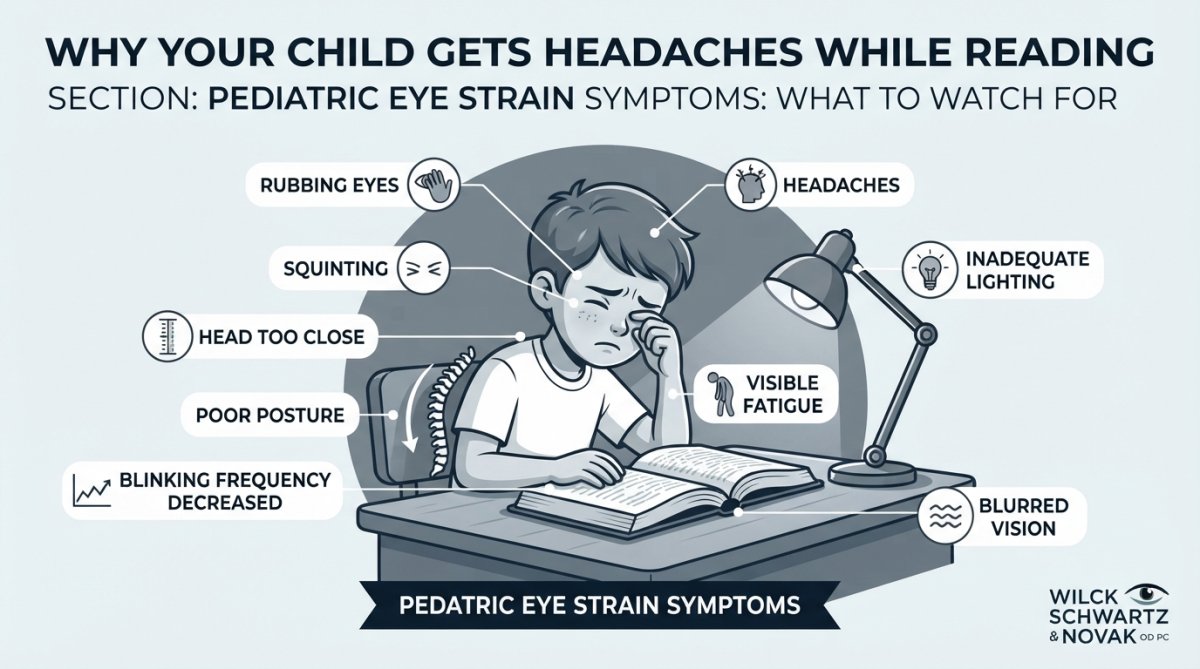
Common symptoms include rubbing the eyes frequently, squinting while reading, tilting the head to one side, holding reading material closer or farther than normal, or complaining that words look blurry or doubled. Some children report that the page seems to move or that they lose their place repeatedly. Others develop sensitivity to light (photophobia) during or after reading.
Behavioral changes are equally important. A child experiencing eye strain might avoid reading altogether, complain of fatigue after short reading sessions, or perform worse academically despite having the ability to understand the material. Some children develop poor reading fluency because their visual system isn't processing text smoothly.
Headaches themselves vary in character. Some children describe a pressure sensation across the forehead or temples. Others report a dull, throbbing ache at the back of the head. If headaches develop during or shortly after reading and resolve with rest, eye strain is a likely culprit. When headaches are consistent and predictable, occurring during or immediately after reading, a vision problem is worth investigating.
How School Eye Screenings Miss Vision Problems
School eye screenings are designed to catch severe vision problems, not the subtle dysfunctions that cause reading headaches. A typical screening uses a visual acuity chart where your child reads letters from 20 feet away. If they can read the 20/20 line, they pass.
It does not test:
- How well the eyes focus up close
- Whether the two eyes work together
- How long the eyes can sustain focus
- Whether there's astigmatism or other refractive errors that appear at certain angles
- Visual processing speed or tracking ability
A child with convergence insufficiency will pass a school screening because they can see the letters clearly from 20 feet away. A child with mild farsightedness that only causes problems during sustained reading will pass. This is why so many parents hear, "Your child's vision is fine," from the school, then watch their child struggle with headaches while reading.
A comprehensive eye exam from an optometrist or ophthalmologist tests near vision, binocular coordination, accommodation, and sustained visual function. It's the difference between a quick screening and a thorough diagnostic evaluation.
Environmental and Behavioral Triggers
Vision problems aren't the only cause of reading headaches. Environmental factors and behavioral habits play a significant role.
Lighting, posture, and screen time
Inadequate or harsh lighting forces the eyes to work harder. If your child reads in dim light, their pupils dilate and the ciliary muscles work harder to maintain focus. Bright overhead lighting or sunlight reflecting off the page creates glare, which causes squinting and strain.
The ideal reading light comes from behind and slightly above the reader, illuminating the page without creating shadows or glare.
Posture matters significantly. When a child slouches or leans forward over a book, the distance from the eyes to the page changes constantly, requiring repeated refocusing. Poor posture also compresses the neck and shoulders, restricting blood flow to the head and eyes. The ideal reading posture is upright, with the book positioned 10-12 inches from the eyes at a slight downward angle.
Screen time introduces additional strain. When reading on a screen, children blink less frequently, allowing the tear film to evaporate and leading to dry eyes. Screens also emit blue light, which can affect focus and increase perceived glare.
Sleep, hydration, and stress
Sleep deprivation impairs the brain's ability to process visual information efficiently. A tired child's visual system fatigues faster. Dehydration reduces tear production, leading to dry eyes that are more prone to fatigue. Stress and anxiety tense the muscles around the eyes and neck, increasing strain.
When to See a Pediatric Ophthalmologist
Schedule an appointment with a pediatric ophthalmologist if:
- Headaches occur consistently during or after reading
- Your child has failed a school eye screening or you suspect a vision problem
- Headaches are accompanied by squinting, eye rubbing, or complaints of blurred vision
- Your child avoids reading or complains that reading is painful
- Headaches are severe or accompanied by other symptoms like nausea or light sensitivity
- Your child has a family history of eye problems or migraines
- Environmental or behavioral changes haven't reduced the headaches
A pediatric ophthalmologist can perform tests that reveal problems a school screening would miss, including tests of near vision, binocular coordination, accommodation, and visual tracking. At Wilck Schwartz & Novak OD PC, a comprehensive eye exam includes advanced testing to identify exactly where the visual system is struggling, allowing for targeted treatment.
How to Prevent Eye Strain in Students
Prevention is always preferable to treatment.
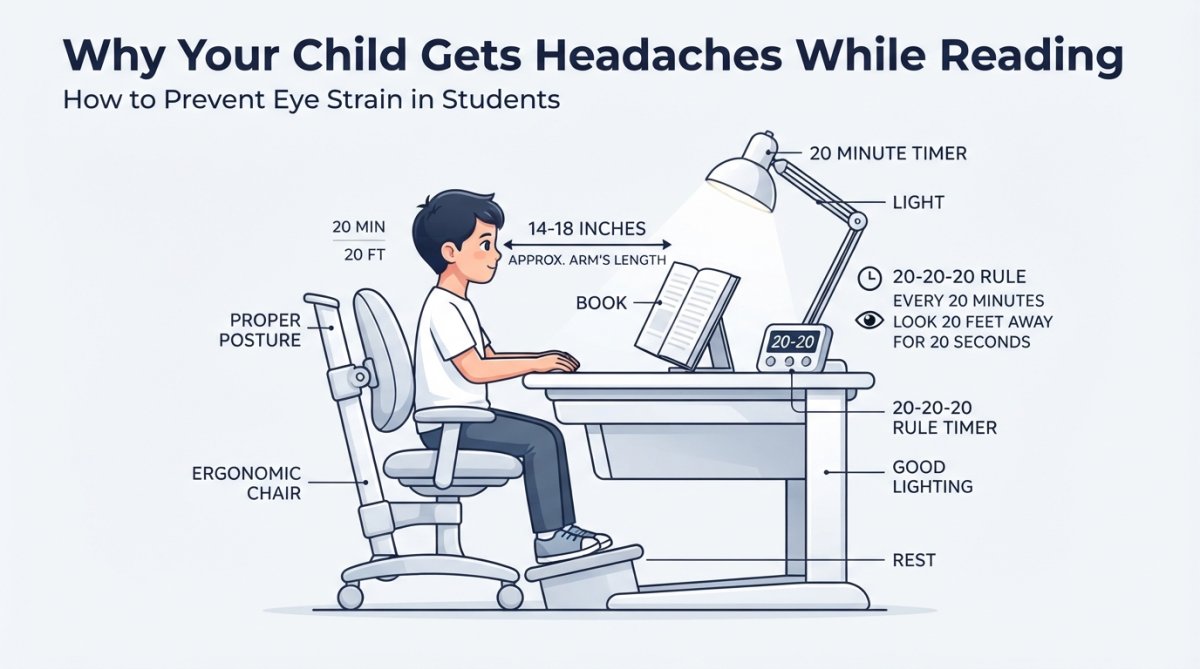
The 20-20-20 rule is simple but effective. Every 20 minutes of reading, have your child take a 20-second break and look at something 20 feet away. This allows the ciliary muscles to relax and the eyes to reset.
Optimize the reading environment. Ensure adequate lighting, position the reading material at the correct distance and angle, and eliminate glare.
Encourage proper posture. Sit upright, keep the book 10-12 inches from the eyes, and relax the shoulders.
Limit screen time and enforce blue light breaks. For every hour of screen time, take a 10-minute break.
Prioritize sleep and hydration. Aim for 8-10 hours of sleep for school-age children, and ensure they drink water throughout the day.
Address stress and anxiety. If reading is stressful, break it into shorter sessions.
Schedule regular eye exams. Annual eye exams catch developing problems early.
What a Comprehensive Eye Exam Reveals
A comprehensive eye exam is fundamentally different from a school screening. It assesses the entire visual system and how it functions during real-world tasks like reading.
A comprehensive exam includes:
- Visual acuity testing at multiple distances
- Refraction to determine if glasses or contacts are needed
- Binocular vision assessment to evaluate how the two eyes work together
- Accommodation testing to measure focusing ability and endurance
- Pupil response and eye movement evaluation
- Intraocular pressure measurement
- Dilated retinal examination to assess the health of the back of the eye
- Visual field testing if indicated
- Assessment of visual processing and tracking ability
For a child with reading headaches, the binocular vision assessment and accommodation testing are particularly important. Some practitioners also perform functional vision testing, which simulates real-world tasks like reading.
Wilck Schwartz & Novak OD PC uses advanced optometric equipment to perform comprehensive evaluations that go far beyond what school screenings can detect, allowing the team to identify the exact source of reading headaches and recommend appropriate interventions.
Reading headaches in children are almost always a sign that something in the visual system needs attention. The good news is that once identified, most causes are highly treatable. A comprehensive eye exam is the essential first step. If your child experiences consistent headaches while reading, don't assume it's normal. Schedule an appointment with Wilck Schwartz & Novak OD PC to assess your child's visual health and get a clear plan for preventing future headaches. Early detection and precise treatment ensure your child can read comfortably and develop strong reading skills without pain.
Frequently Asked Questions
Why does my child get headaches when reading if the school eye screening said vision is fine?
School screenings test distance vision only and check basic acuity. They typically miss convergence insufficiency, binocular vision dysfunction, and refractive errors that only emerge during sustained near work like reading. A comprehensive eye exam evaluates how your child's eyes work together at reading distance, measures accommodation (focusing ability), and assesses visual processing, areas school screenings don't cover. Many children pass screenings but still experience eye strain and reading headaches due to these overlooked vision issues.
What are the signs of eye strain in children that cause reading headaches?
Common pediatric eye strain symptoms include headaches during or after reading, squinting or tilting the head to focus, rubbing eyes frequently, losing place while reading, blurred vision after short reading periods, and complaints that words appear to move or double. Some children show behavioral signs: avoiding reading, difficulty with reading comprehension, or fatigue that worsens as the day progresses. If your child displays these pediatric eye strain symptoms alongside reading headaches, a comprehensive eye exam is important to rule out vision problems.
When should I take my child to an eye doctor for reading headaches?
Schedule an appointment when to see a pediatric ophthalmologist if headaches happen consistently during reading, occur several times per week, interfere with schoolwork or homework, persist despite rest, or are accompanied by blurred vision, double vision, or eye discomfort. Also seek evaluation if your child avoids reading, squints frequently, or tilts their head to focus. Even if school screenings are normal, these signs warrant a comprehensive eye exam to identify vision-related causes and prevent long-term academic impact.
How can I help my child prevent eye strain headaches while reading?
Implement the 20-20-20 rule: every 20 minutes of reading, take a 20-second break and look at something 20 feet away. Ensure proper lighting without glare, position reading material 10-12 inches from the eyes, and maintain good posture with shoulders relaxed. Limit screen time before reading sessions, ensure adequate sleep and hydration, and manage stress through breaks and physical activity. These strategies reduce visual fatigue, but if headaches persist despite these adjustments, a comprehensive eye exam can identify underlying vision problems requiring professional correction.
This article was written using GrandRanker