 how-to
How to Clean Reusable Contact Lens Cases Properly
Table of Contents
- Why Reusable Contact Lens Cases Need Proper Cleaning
- What You'll Need to Clean Your Contact Lens Cases
- Step-by-Step: How to Clean Reusable Contact Lens Cases Properly
- Contact Lens Case Hygiene Best Practices
- The Dangers of Using Tap Water on Contact Lenses and Cases
- How Often to Replace Your Contact Lens Case
- Common Mistakes to Avoid with Contact Lens Cases
- Conclusion
- Frequently Asked Questions
Last Updated: September 15, 2026
Why Reusable Contact Lens Cases Need Proper Cleaning
A contact lens case is not a neutral container. It is a warm, moist, enclosed environment, and that is exactly what microorganisms need to multiply. Research summarized by the Centers for Disease Control and Prevention on contact lens hygiene shows that poor case care is one of the leading contributors to contact lens-related eye infections, including microbial keratitis. At Wilck Schwartz & Novak OD PC, we see the consequences in our exam chair: redness, pain, light sensitivity, and in serious cases, corneal damage that can threaten vision. The fix takes about two minutes a day. Below, we break down exactly how to clean reusable contact lens cases properly, from hand washing to replacement schedules, so you can protect your corneal health between eye exams.
What You'll Need to Clean Your Contact Lens Cases
Gather these five items before you start. Each one exists for a specific reason, and substituting the wrong product can do more harm than skipping the cleaning altogether.
- Fresh sterile contact lens solution (multi-purpose solution or saline, never homemade)
- Clean hands washed with antibacterial soap and dried with a lint-free towel
- A lint-free cloth or paper towel for drying the exterior
- Clean air for air-drying, meaning an open, dust-free spot
- A calendar or reminder for tracking lens case replacement
That last item sounds trivial. It is not. Most case problems we see are not caused by laziness, they are caused by people who clean diligently but never replace the case.
Step-by-Step: How to Clean Reusable Contact Lens Cases Properly
Cleaning takes under three minutes per session. Follow the sequence below in order, because skipping a step, especially the air-dry stage, undermines everything that comes before it.
Step 1: Wash Your Hands First
Wash with antibacterial soap and water, then dry with a lint-free towel. Hand hygiene before handling is non-negotiable: whatever is on your fingers ends up in the wells, and from there, on your eyes. Avoid oil-based or scented soaps, which leave residue that can irritate the eye.
Step 2: Empty and Rinse Each Well
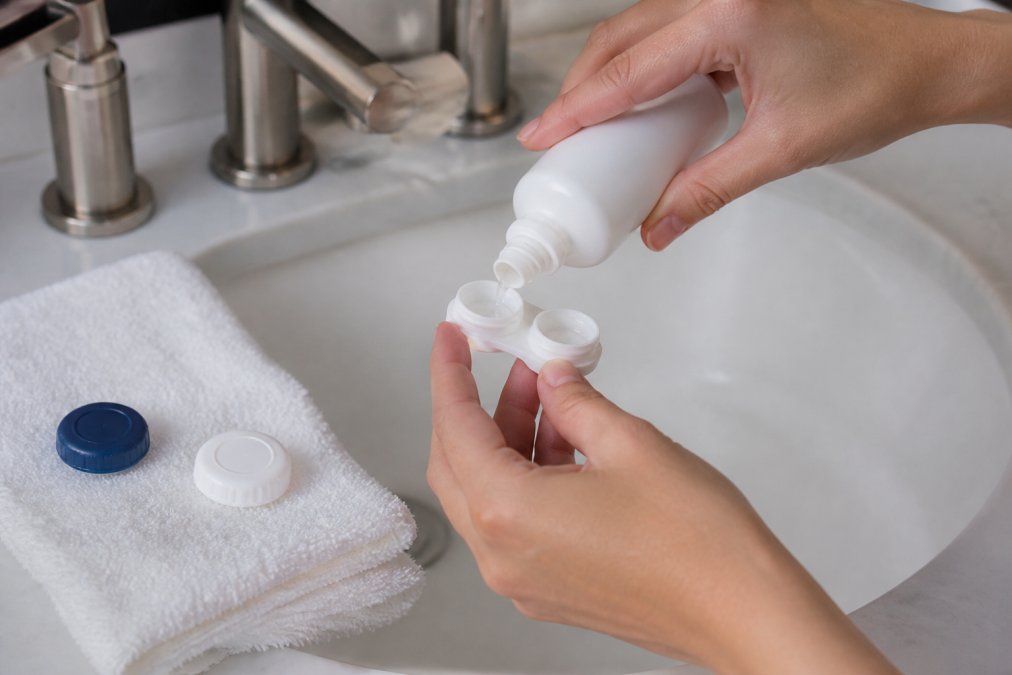
Discard the old solution. Never top off, which means adding fresh solution on top of the old. Doing so dilutes the disinfectant and leaves a film where biofilm can form. Rinse each well with fresh sterile contact lens solution, not water.
Step 3: Rub, Rinse, and Air-Dry
Rub the inside of each well with clean fingers or a lens case cleaning swab, then rinse again with fresh solution. Place both caps and the case upside down on a lint-free towel and let them air-dry completely. Air-drying is the step most people rush, and it is the one that matters most: moisture left in a closed case is a breeding ground for pathogens.
Contact Lens Case Hygiene Best Practices
Beyond the daily routine, a few habits separate people who rarely have lens problems from people who have them repeatedly. Contact lens case hygiene best practices come down to three rules: use fresh solution every time, store the case open and upside down when not in use, and keep the case away from bathrooms' most contaminated zones, such as near the toilet or directly beside the sink spray.
- Store the case with caps off so it dries fully between uses
- Replace the solution in the wells every single day, even if you skip wearing lenses
- Keep the case in a clean, dry location, not a humid bathroom cabinet
- Never share a case, even within a family
The American Optometric Association's contact lens care guidance makes the same point in its patient resources: lens care and case care are a single routine, not two separate chores.
The Dangers of Using Tap Water on Contact Lenses and Cases
Tap water is not sterile, and that is the entire problem. The dangers of using tap water on contact lenses and cases stem from microorganisms that are harmless when swallowed but dangerous on the cornea: Pseudomonas, Acanthamoeba, and various fungi. These pathogens can survive in a case for days and transfer to the lens the next time you store it. Symptoms of a resulting eye infection include pain, redness, blurred vision, and light sensitivity, and they warrant prompt evaluation rather than waiting to see if things improve.
How Often to Replace Your Contact Lens Case
Replace the case every three months, without exception (the CDC). This is the single most commonly skipped recommendation in contact lens care, and it is the one most likely to be the difference between a comfortable lens year and a corneal infection. A case can look perfectly clean and still harbor biofilm, the thin, sticky layer of microorganisms that clings to plastic surfaces and resists rinsing. Because biofilm is not always visible, "it looks fine" is not a reliable test. Mark the replacement date on your calendar the day you open a new case.
Why Three Months Is the Threshold
The three-month interval is not arbitrary. Every time you open and close the case, the plastic surface picks up micro-abrasions. Those scratches give biofilm a place to anchor where rinsing cannot reach it. Multi-purpose solution is formulated to disinfect lenses, not to sterilize the inside of a scratched plastic well, so once the surface degrades, no cleaning routine fully compensates. Most practitioners find that cases used past the three-month mark show measurable surface wear even when they appear clear to the naked eye.
Visual Inspection Guide: When a Case Is Beyond Cleaning
Once a week, hold the case under bright light, a bathroom vanity light or a phone flashlight works, and check for the following. Any single item on this list means replace the case now, not at the next scheduled date.
- Cloudy or hazy wells. A healthy case interior is clear. Cloudiness usually means biofilm or mineral film has bonded to the plastic.
- White, chalky, or crusty deposits. These are typically mineral buildup from solution residue. They do not rinse away and they roughen the surface.
- Visible scratches or gouges. Run a fingernail lightly along the inside wall. If you can feel ridges, the surface is compromised.
- Discoloration. Yellowing, browning, or a pinkish tint suggests microbial or fungal colonization.
- Cracks at the cap threads or well rim. Cracks trap solution and debris and cannot be cleaned.
- A persistent odor. A case that smells off after cleaning should be discarded.
- Slimy or slippery feel after rinsing. This is the classic biofilm signature and the clearest sign the case is done.
If you are unsure whether what you are seeing is a stain or a deposit, replace the case. Cases cost a few dollars; treating a corneal infection does not.
Do Antimicrobial and Silver-Ion Cases Need Different Care?
Some reusable cases are marketed as antimicrobial or silver-ion cases. These designs embed silver ions in the plastic to slow bacterial growth on the case surface. They do not disinfect your lenses, and they do not change the cleaning routine. You still empty, rinse with fresh solution, rub, and air-dry daily, and you still replace the case on schedule. What does change is the inspection standard: silver-ion cases can discolor or develop a gray or dark tint as the silver is depleted, and once that happens the antimicrobial benefit is largely gone even if the case still looks structurally sound. Treat visible silver depletion as a replacement trigger.
| Item | Action | Frequency |
|---|---|---|
| Contact lens case (standard or antimicrobial) | Replace completely | Every 3 months, or sooner if inspection fails |
| Case solution | Empty and refill with fresh solution | Daily |
| Case cleaning | Rub, rinse, air-dry upside down | Daily |
| Visual inspection | Check wells under bright light | Weekly |
| Hand washing | Antibacterial soap before handling | Every use |
Common Mistakes to Avoid with Contact Lens Cases
Cleaning Your Case While Traveling
Disposal and Environmental Impact
Conclusion
Frequently Asked Questions
Can you clean and reuse contact lens cases?
Yes, reusable contact lens cases can be cleaned and reused, but they don't last forever. The CDC recommends replacing them at least every three months. Clean them daily by emptying the old solution, rinsing with fresh multi-purpose solution, and air-drying face down on a clean tissue. Never use tap water, which can introduce microorganisms that cause eye infections.
What is the best way to clean a contact lens case?
Empty both wells, rinse with fresh sterile contact lens solution, and wipe with a clean, lint-free cloth. Then place the case upside down with caps off to air-dry completely. Avoid tap water and never top off old solution. This routine removes biofilm and residue that can harbor pathogens.
Is it okay to boil my contact lens case?
No, boiling is not recommended. High heat can warp the plastic, creating cracks where bacteria can hide. The FDA and eye care professionals advise against boiling; instead, follow the manufacturer's cleaning instructions and replace the case every three months.
How often should you replace your contact lens case?
Replace your contact lens case at least every three months, or sooner if it becomes cracked, discolored, or difficult to clean. The CDC sets this three-month guideline because biofilm and bacteria accumulate over time, raising the risk of keratitis and other eye infections. Mark your calendar to stay on schedule.