 how-to
How to Identify Vision Problems in Toddlers: Signs to Know
Table of Contents
- Common Signs of Vision Problems in Toddlers
- Physical Symptoms and Behavioral Indicators to Watch For
- Age-Specific Developmental Checklists for Vision Milestones
- Common Eye Problems in Toddlers: Strabismus, Amblyopia, and Refractive Errors
- When to Schedule Pediatric Eye Exams
- How to Prepare a Toddler for an Eye Exam
- Home-Based Vision Screening Games and Digital Eye Strain in the Tablet Era
- Frequently Asked Questions
Last Updated: September 12, 2026
Common Signs of Vision Problems in Toddlers
Spotting signs of vision problems in toddlers starts with watching how your child uses their eyes during everyday play. A toddler who consistently squints, tilts their head, or holds books unusually close may be compensating for blurry vision, habits easy to dismiss as quirks. At Wilck Schwartz & Novak OD PC, we've helped Brooklyn families spot these early cues since 1964.
Most parents miss this: toddlers rarely say "I can't see well" because they don't know what normal vision looks like, they adapt instead.

Watch for these behaviors during daily routines:
- Squinting, squishing one eye shut, or excessive blinking
- Rubbing eyes frequently, even when tired
- Tilting the head or covering one eye to focus
- Sitting unusually close to the TV or holding toys near the face
- Bumping into furniture or misjudging stairs and curbs
- Losing interest in picture books or puzzles quickly
One symptom alone rarely means something is wrong; a pattern across weeks and settings deserves a professional look.
Physical Symptoms and Behavioral Indicators to Watch For
Physical symptoms of eye strain in toddlers look different from adult complaints. Instead of saying their eyes hurt, a toddler may rub them constantly, become irritable during focused activities, or develop headaches after screen time or drawing. Light sensitivity, watery eyes, and lingering redness can also signal an underlying issue rather than tiredness.
Behavioral indicators matter just as much. A child who avoids coloring, loses their place during storytime, or gives up on puzzles faster than peers may be struggling to see clearly rather than losing interest.
Vision problems in toddlers often surface first as mood or attention changes, not eye complaints. A child who loved books and now refuses them is telling you something.
Keep a two-week log: the behavior, the time of day, and what your child was doing. This turns vague concerns into patterns your eye doctor can investigate.
Age-Specific Developmental Checklists for Vision Milestones
Most articles lump every child from two to five into one "toddler" bucket, but the visual skills a 2-year-old is building differ from a 4-year-old's. This split checklist lets you judge your child against the right reference point, and know which misses are "watch and wait" versus "call this week."
Use these as a map, not a test: children develop on their own timelines, and a single missed item is rarely meaningful.
Ages 2 to 3: Building the Basics
At this stage, vision is still wiring itself to the brain. Watch whether both eyes participate and whether vision drives movement.
- Eye contact and face recognition: Your child should recognize you and familiar caregivers across a room, not just up close.
- Tracking: Both eyes should follow a moving toy, a ball rolled across the floor, a bubble drifting, smoothly and together, without one eye lagging or drifting off.
- Reaching and grasping: They should reach accurately for small objects like a Cheerio or a block, not grope or overshoot.
- Pointing: By around 18 to 24 months, pointing at things they want (a cup, a dog, a picture) shows they're using distance vision to communicate.
- Stacking and scribbling: Stacking 4 to 6 blocks and making intentional scribble marks reflects hand-eye coordination that depends on clear near vision.
Red flags at this age: a persistent head tilt, one eye that turns in or out even occasionally, or a child who never seems to notice things happening across the room.
Ages 4 to 5: Refining and Integrating
By this point, the eyes and brain should work as a coordinated team. Depth perception, focusing, and switching between near and far tasks mature here.
- Shape and letter recognition: Recognizing basic shapes and some letters by sight, not just by memory, signals that near vision is sharp enough for early literacy.
- Depth and stairs: Navigating stairs and playground equipment confidently, without clinging or misjudging steps, reflects working depth perception.
- Picture book behavior: Holding a book at a normal distance rather than against the nose, and following a story across a page without losing their place.
- Distance naming: Naming familiar objects or people across a parking lot or playground, not just within arm's reach.
- Sustained near work: Completing a puzzle or coloring page for several minutes without rubbing eyes, squinting, or pushing the page away.
Red flags at this age: avoiding close-up work entirely, complaining of headaches after drawing or screen time, or consistently closing one eye to see.
How to Tell a Miss From a Delay
A missed milestone is a reason to observe more closely, not to panic. What matters is persistence and consistency: a skill missing across weeks, in multiple settings, that doesn't improve with practice warrants a professional evaluation. A skill a few months behind while everything else is on track usually just needs time.
If your child misses more than one item in their age band, or a red flag repeats, schedule a comprehensive exam rather than wait for the next well-child visit.
Common Eye Problems in Toddlers: Strabismus, Amblyopia, and Refractive Errors
Common eye problems in toddlers fall into three groups, each best caught early.
Strabismus is when the eyes don't point in the same direction, misaligned or crossed eyes. You may notice one eye drifting inward, outward, up, or down, especially when your child is tired.
Amblyopia, or lazy eye, happens when one eye sends a weaker signal to the brain. The brain favors the stronger eye, and vision in the weaker one doesn't develop properly. It's often invisible because the eyes can look perfectly straight.
Refractive errors include nearsightedness, farsightedness, and astigmatism, the eye doesn't focus light correctly, causing blurred vision at certain distances.
| Condition | What Parents Notice | Why Early Care Matters |
|---|---|---|
| Strabismus | One eye drifts or turns | Alignment is easier to correct young |
| Amblyopia | Often nothing obvious | Brain-eye connection strengthens before age 7 |
| Refractive errors | Squinting, sitting close | Glasses prevent learning delays |
These conditions rarely resolve on their own, and the toddler years are when treatment tends to work best.
When to Schedule Pediatric Eye Exams
Schedule a pediatric eye exam if you notice any persistent sign from this article, if your child misses a developmental milestone, or if there's a family history of vision problems. Many professionals also recommend a first comprehensive exam around age three, with earlier checks if concerns arise (aoa.org).
School or pediatrician screenings are a useful first filter but not a substitute for a comprehensive eye exam. They typically check distance acuity and may miss binocular vision problems, eye coordination issues, and conditions like amblyopia that don't affect a single-eye reading chart. If your child complains of headaches when reading despite passing a screening, that gap is why a full exam matters.
A family history of strabismus, amblyopia, or childhood glasses is one of the strongest reasons to book early rather than wait for symptoms.
How to Prepare a Toddler for an Eye Exam
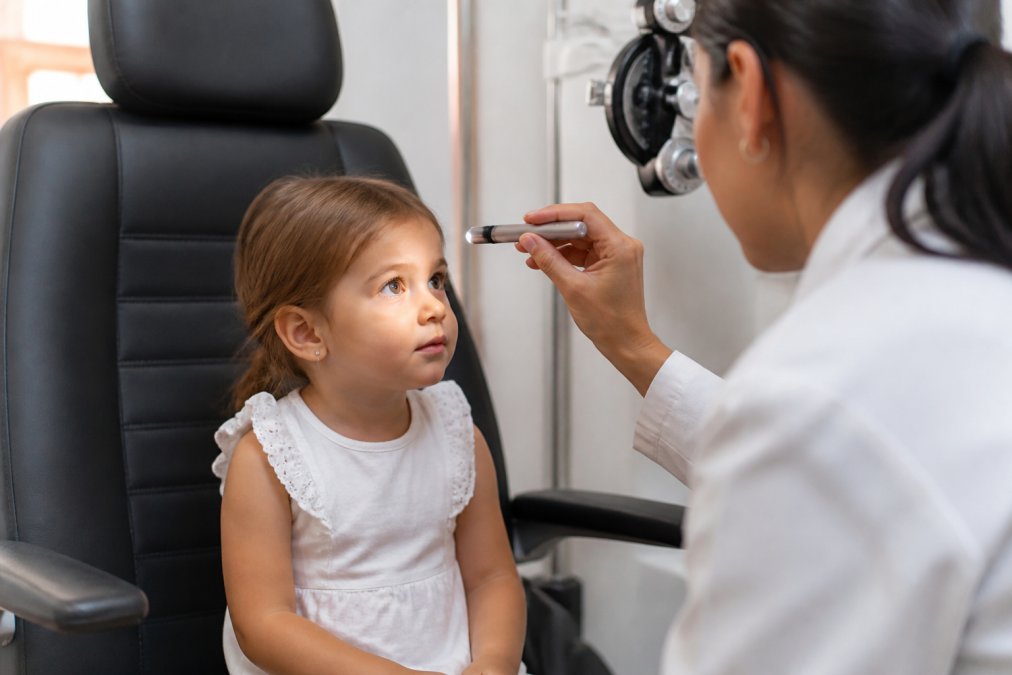
Preparing a toddler for an eye exam comes down to familiarity and calm. Tell your child a day ahead that someone will look at their eyes with a light and ask them to look at pictures. Keep it short and positive.
A few practical steps make the visit smoother:
- Bring a favorite small toy or stuffed animal for comfort
- Schedule for a time your child is usually well-rested, not near naptime
- Let them watch you stay calm and relaxed in the room
- Bring snacks and a comfort item for after the appointment
- Avoid promising "no drops" in case dilating drops are needed
If your child is anxious, say so when you book. A caring team can adjust the pace and give you extra time.
American Optometric Association guidance on children's vision
Home-Based Vision Screening Games and Digital Eye Strain in the Tablet Era
Home screening games won't diagnose anything, but they give you structured observations to bring to a professional, far more useful than a vague "something seems off." Run each when your child is rested and cooperative, and repeat on different days so you're seeing a pattern, not a mood.
Four Games That Reveal Real Clues
1. The tracking game. Hold a small, high-contrast toy (a bright ball or rattle) about 12 to 16 inches from your child's face. Move it slowly side to side, then up and down, in a smooth arc. Both eyes should move together, stay locked on the toy, and not lag or drift. If one eye consistently trails, overshoots, or wanders off, note it.
2. The cover-and-name game. Cover one eye gently with your hand or a card, hold up a picture, and ask your child to name it. Then switch eyes. Look for a difference between the two eyes, more squinting, leaning in, reluctance, or errors with one eye covered versus the other. A child happy with one eye covered and fussy with the other is showing you something.
3. The distance-pointing game. Place a familiar toy 10 to 15 feet away and ask your child to point to or name it. Watch for squinting, leaning forward, or walking toward it instead of identifying it from where they stand. Repeat with a slightly smaller object to make it harder.
4. The near-work stamina game. Give your child a puzzle or coloring page and watch for a few minutes without intervening. Do they bring the page unusually close? Push it away? Rub their eyes? Give up faster than you'd expect? Stamina during close work is one of the clearest everyday signals of a focusing or near-vision problem.
What Your Results Actually Mean
None of these games can confirm a diagnosis. What they can do is surface a consistent asymmetry, one eye performing noticeably worse than the other, or near work consistently triggering discomfort. Asymmetry is the most useful thing to report, because conditions like amblyopia often hide behind eyes that look perfectly straight and a child who seems to function fine.
Digital Eye Strain in the Tablet Era
Today's toddlers are the first generation to grow up with a tablet within arm's reach, and that changes the strain profile. The core issue is sustained near focus at a short distance: when a child stares at a screen held 8 to 10 inches away for long stretches, the eyes stay locked in close-focus mode, blink rate drops, and the muscles controlling focusing and alignment fatigue.
What that looks like in a toddler:
- Eye rubbing and excessive blinking during or right after screen time
- Irritability or meltdowns that cluster around tablet sessions
- Holding the screen very close to the face
- Complaining of headaches (or acting out) after 20-plus minutes of screen use
- Watery or red eyes that clear once the screen is put away
The practical fix is simple and doesn't require eliminating screens:
- Shorter sessions: Keep individual screen sessions short for young children, and break them up rather than letting them run long.
- More distance: Encourage holding the screen farther away, arm's length rather than nose-to-glass.
- Frequent breaks: Pause every so often so the eyes shift to distance and reset.
- Outdoor time: Time spent looking at things far away gives the focusing system a genuine rest.
The American Academy of Pediatrics guidance on screen time recommends consistent limits for young children, and following them supports eye comfort alongside overall development.
When It's Sensory, Not Visual
One distinction most articles skip: some children have sensory processing differences that mimic vision problems. A child who avoids bright light, squints in ordinary indoor lighting, or refuses certain textures near their face may be reacting to sensory input rather than struggling to see. The tell is often that vision checks come back normal and the behavior spans many senses, not just sight. If that pattern fits, raise it with your pediatrician alongside any eye concerns.
Frequently Asked Questions
How can I test my toddler's vision at home?
Try simple games: roll a ball and see if your toddler tracks it smoothly with both eyes. Cover one eye at a time and check if they react differently. Point to distant objects and ask them to name what they see. These home-based vision screening games can reveal tracking or focusing issues, but they don't replace a comprehensive eye exam. If you notice squinting or eye rubbing, schedule a professional evaluation.
What are common physical signs of vision problems in toddlers?
Watch for excessive blinking, eye rubbing, light sensitivity, and headaches. Your toddler might tilt their head or close one eye to see better. Misaligned eyes (strabismus) or a white pupil reflex are red flags. These physical symptoms of eye strain often appear during near tasks like coloring or looking at screens. Note any behavior that suggests blurred vision or discomfort and discuss it with an eye doctor.
At what age should a child have their first comprehensive eye exam?
Many professionals recommend a first comprehensive eye exam around age three, with earlier checks if concerns arise. If you notice signs of vision problems in toddlers, don't wait. Early detection of conditions like amblyopia or refractive errors can prevent long-term vision loss. A pediatric eye care professional can assess visual acuity, eye coordination, and ocular health even if your child can't read letters.
How do I know if my toddler needs glasses?
If your toddler consistently squints, holds objects very close, or complains of headaches, they may need glasses. Refractive errors like nearsightedness, farsightedness, or astigmatism can affect depth perception and hand-eye coordination. An optometrist can measure your child's prescription objectively, even without verbal feedback. Glasses can correct focusing issues and support normal visual development during these critical early years.