 how-to guide
Contact Lens Fitting Specialist Brooklyn: Complete Guide
Table of Contents
- Why You Need a Contact Lens Fitting Specialist in Brooklyn
- What to Expect at a Contact Lens Fitting in Brooklyn
- Contact Lens Exam vs. Routine Eye Exam: What's the Difference
- Specialty Contact Lens Fitting in Brooklyn for Complex Prescriptions
- Troubleshooting Common Contact Lens Fitting Issues
- Cost of Contact Lens Exam in Brooklyn and Payment Options
- Step-by-Step Guide for First-Time Contact Lens Wearers
- Contact Lens Materials and Brands: What Works Best
Last Updated: July 25, 2026
Finding the right contact lens fitting specialist Brooklyn requires understanding what separates a proper fitting from a rushed prescription. A specialized contact lens fitting involves precise measurements, advanced diagnostic equipment, and expertise in matching lenses to individual corneal anatomy. At Wilck Schwartz & Novak OD PC, we've spent decades perfecting this process for patients across Brooklyn.
Why You Need a Contact Lens Fitting Specialist in Brooklyn
Contact lenses sit directly on your cornea, requiring far more precision than glasses. A contact lens fitting specialist Brooklyn conducts a comprehensive assessment of your eye's shape, tear film quality, and health status, not just writing a prescription. Corneal topography varies dramatically from person to person; a tiny difference in base curve creates enormous comfort problems if overlooked.
The Difference Between Online Prescriptions and Professional Fitting
An online contact lens prescription is typically just a number from a routine eye exam. It doesn't account for the physical dimensions of your eye or how your cornea will respond to lens material. Professional fitting adds layers of assessment that online options cannot replicate.
During a professional fitting, your eye doctor measures your corneal curvature using a keratometer or corneal topography system. They evaluate tear film quantity and quality, assess lid position and blink mechanics, and consider your lifestyle and daily lens-wearing hours. Online prescriptions skip these steps entirely, often resulting in uncomfortable lenses that slip or cause dryness.
What to Expect at a Contact Lens Fitting in Brooklyn
A professional contact lens fitting typically takes 45 minutes to an hour, with every step serving a purpose in ensuring your lenses will work long-term.
Eye Health Assessment and Tear Film Evaluation
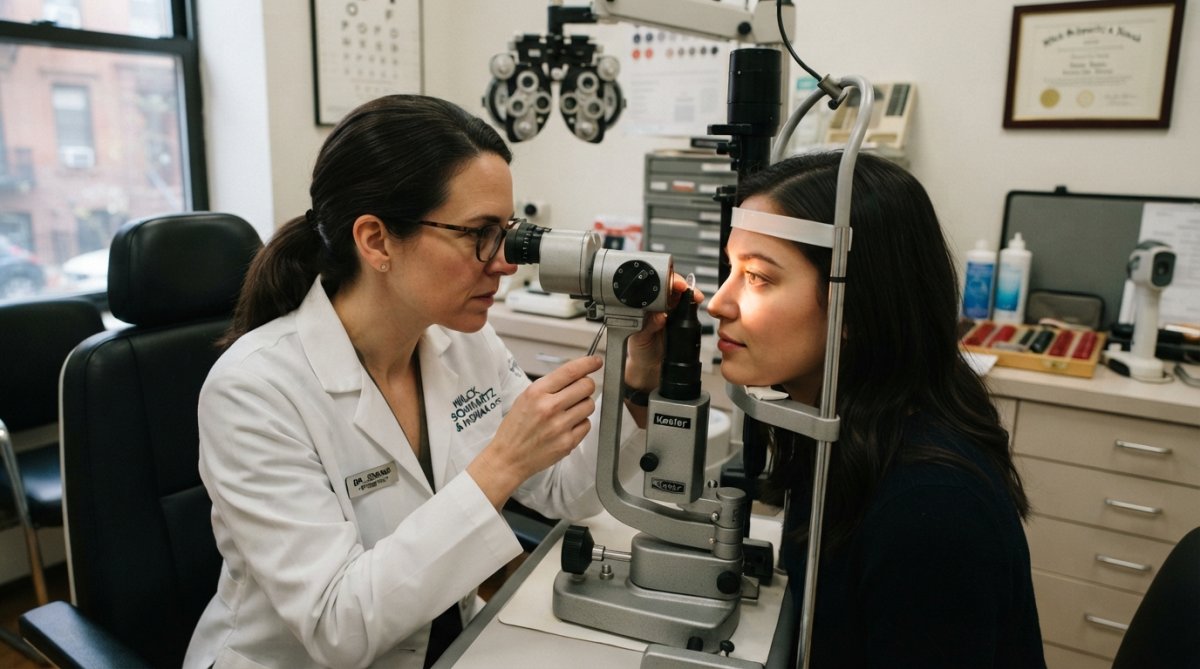
The fitting begins with a comprehensive eye health assessment. Your eye doctor checks visual acuity, measures intraocular pressure, and examines the front and back of your eye using a slit lamp, looking for conditions that might affect lens tolerance such as dry eye syndrome, allergies, or corneal scarring.
Tear film evaluation is critical. Your tears must maintain a stable layer between your eye and the lens. A contact lens fitting specialist Brooklyn tests tear quantity using a Schirmer test and evaluates tear quality by observing how the tear film breaks apart on your cornea. These tests determine which lens materials and wear schedules will work best for you.
Precise Measurements: Base Curve and Lens Diameter
Base curve is the radius of curvature of the back surface of the lens and must match your corneal curvature closely; too steep and the lens will adhere uncomfortably, too flat and it will slide around and blur your vision. Modern topography provides a detailed map of your cornea's shape, revealing any irregularities that might require specialty lenses.
Lens diameter affects how the lens centers on your eye and how your eyelids interact with it. Your contact lens fitting specialist Brooklyn measures the horizontal white-to-white distance of your eye and considers your lid position to select the appropriate diameter.
Contact Lens Trial and Follow-Up Visit
After measurements, your eye doctor will place trial lenses on your eyes. You'll wear these for 15-20 minutes while your eyes acclimate. Based on your feedback about comfort and vision clarity, they may adjust the base curve, diameter, or material.
A follow-up visit is essential, typically scheduled for one week after you begin wearing your new lenses. At this visit, your eye doctor evaluates how your cornea has responded to the lenses and confirms that vision and comfort remain stable.
Contact Lens Exam vs. Routine Eye Exam: What's the Difference
A routine eye exam focuses on your overall ocular health and refractive error, typically taking 30-45 minutes. A contact lens exam includes all routine exam elements plus additional testing specific to lens wear: corneal topography, tear film analysis, and eyelid anatomy evaluation. Your eye doctor discusses your lifestyle and work environment to determine which lens type will serve you best, performs trial fittings, and schedules follow-up visits. A contact lens exam typically takes 60-90 minutes and costs more because it requires specialized equipment and expertise.
Specialty Contact Lens Fitting in Brooklyn for Complex Prescriptions
Standard soft contact lenses work well for many people, but some patients have corneal irregularities, extreme prescriptions, or specific vision needs that require specialty lenses.
Scleral Lenses for Keratoconus and Corneal Irregularities
Scleral lenses are large-diameter rigid gas permeable lenses that vault over the cornea and rest on the sclera (the white of your eye). They're designed for patients with keratoconus, post-surgical corneal scarring, or other corneal irregularities that make standard lenses uncomfortable or ineffective.
Keratoconus is a progressive condition where the cornea thins and becomes cone-shaped, distorting vision and making standard lenses difficult to fit. Scleral lenses bypass the cornea entirely by resting on the sclera, where the eye's surface is smoother. This allows for clear, stable vision even with severe corneal irregularities. Fitting scleral lenses requires advanced topography and specialized expertise.
Toric Lenses for Astigmatism
Astigmatism occurs when your cornea or lens is irregularly shaped, causing blurred or distorted vision. Standard spherical contact lenses don't address the cylindrical error that astigmatism creates. Toric lenses have different powers in different meridians, allowing them to correct both spherical and cylindrical errors simultaneously.
Fitting toric lenses is more complex because the lens must maintain a specific orientation on your eye. If the lens rotates, the correction shifts and vision blurs. Your eye doctor measures your corneal astigmatism and lid anatomy to select a toric lens with the appropriate axis and stabilization design.
Multifocal and Extended Wear Options
Multifocal contact lenses correct presbyopia, the age-related loss of focusing ability that typically begins around age 40. These lenses have multiple zones of power, allowing you to see clearly at distance, intermediate, and near distances. Fitting multifocals requires understanding how your eyes work together and how your pupils respond to different lighting conditions.
Extended wear lenses are designed to be worn overnight for up to 30 days continuously. These lenses must allow exceptional oxygen transmission to keep your cornea healthy during sleep. A contact lens fitting specialist Brooklyn will monitor your corneal health closely if you choose extended wear because sleeping in lenses carries a higher risk of complications if not managed properly.
Troubleshooting Common Contact Lens Fitting Issues
Even with professional fitting, some patients experience problems. Understanding what causes these issues and how to fix them separates a good contact lens fitting specialist Brooklyn from an average one.
Dry Eye Syndrome and Lens Comfort
Dry eye syndrome is the most common reason people abandon contact lenses. Contact lenses sit on your tear film and can disrupt its stability. If your baseline tear production is low or your tear quality is poor, lenses will exacerbate the problem.
A contact lens fitting specialist Brooklyn addresses dry eye by selecting lens materials with high water content or silicone hydrogel properties that allow better oxygen transmission. They may recommend daily disposable lenses, which eliminate the problem of lens deposits that accumulate with reusable lenses, or suggest rewetting drops specifically formulated for contact lens wearers.
Poor Fit and Prescription Adjustments
A poor fit manifests as vision that fluctuates, lenses that slip during the day, or persistent discomfort that doesn't improve after a week of wear. This typically indicates that your base curve is incorrect, your lens diameter is wrong, or your prescription needs refinement.
If your vision fluctuates, your lens may be too steep or too flat. If your lenses slip downward, your base curve is too flat. If your lenses feel stuck, your base curve is too steep. A contact lens fitting specialist Brooklyn will perform additional corneal topography and re-examine lens movement on your eye to diagnose the problem, then fit trial lenses with adjusted parameters.
Cost of Contact Lens Exam in Brooklyn and Payment Options
Contact lens fitting costs vary depending on the complexity of your case and the type of lenses you need. Basic soft lens fittings are less expensive than specialty fittings for keratoconus or scleral lenses. For specific costs and payment options, contact Wilck Schwartz & Novak OD PC directly to discuss your individual situation and insurance coverage.
Vision Insurance and Fitting Fees
Many vision insurance plans cover a portion of contact lens exams and lenses. Some plans include a fitting fee allowance; others require you to pay out of pocket. Review your plan details before your appointment so you understand your out-of-pocket costs.
Wilck Schwartz & Novak OD PC accepts most major vision insurance plans and can verify your coverage before your appointment. If you don't have insurance, ask about cash-pay pricing and whether the practice offers payment plans or discounts for purchasing multiple boxes of lenses at once.
Step-by-Step Guide for First-Time Contact Lens Wearers
If you've never worn contact lenses before, understanding what to expect and how to care for your lenses makes the transition smoother.
Insertion and Removal Techniques
Inserting a contact lens requires practice. Wash and dry your hands thoroughly, place the lens on the tip of your index finger, pull down your lower lid and look straight ahead, then gently place the lens directly on your cornea. Release your lid and blink several times; the lens will center itself on your cornea.
Removal follows a similar process: wash and dry your hands, look straight ahead and pull down your lower lid, use your index finger to gently slide the lens down onto the white of your eye, then pinch the lens gently between your finger and thumb to remove it. Place the lens in fresh solution in your lens case.
Daily Care and Lens Hygiene
Contact lens care is non-negotiable. Improper care leads to infections, corneal ulcers, and potentially permanent vision loss. Clean your lens case daily with fresh solution and replace it every three months. Use only approved contact lens solution, never saline solution, water, or saliva. Never sleep in daily wear lenses. Remove your lenses before swimming or showering. Wash your hands before handling lenses; this is the single most important step in preventing infections.
Contact Lens Materials and Brands: What Works Best
Contact lens materials vary significantly in their oxygen permeability, water content, and how they interact with your tear film.
Daily Disposables vs. Extended Wear
Daily disposable lenses are worn for a single day and then discarded. You start each morning with a fresh lens, eliminating the need for cleaning and storage. Daily disposables are ideal for people with dry eyes, allergies, or busy lifestyles because they don't accumulate deposits. The downside is cost; daily disposables are more expensive per month than weekly or monthly lenses.
Extended wear lenses are designed to be worn for multiple days or weeks continuously, including overnight. These lenses must have exceptional oxygen permeability to keep your cornea healthy during sleep. Extended wear is convenient, but sleeping in lenses increases your risk of infection if you don't follow strict hygiene protocols.
Rigid Gas Permeable (RGP) and Soft Lens Comparison
Rigid gas permeable lenses are made from firm plastic that allows oxygen to pass through. They're more durable than soft lenses and don't accumulate deposits as quickly. RGP lenses provide sharper vision than soft lenses for many people, especially those with astigmatism or keratoconus. The downside is comfort; RGP lenses take longer to adapt to because they're firmer.
Soft lenses are made from hydrogel or silicone hydrogel materials that contain water. They're immediately comfortable because they're flexible and conform to your eye's shape. Soft lenses are easier to adapt to than RGP lenses, making them ideal for first-time wearers. However, soft lenses accumulate deposits more quickly and require daily cleaning.
Choosing the right contact lens fitting specialist Brooklyn is one of the most important decisions you'll make for your eye health. The difference between a rushed fitting and a thorough one often determines whether you'll enjoy wearing lenses or abandon them in frustration. At Wilck Schwartz & Novak OD PC, our team uses advanced optometric equipment and takes the time to understand your eyes, lifestyle, and vision goals. We've been serving the Brooklyn area since 1964, building relationships with multigenerational families who trust us with their eye care. Contact Wilck Schwartz & Novak OD PC today to schedule your comprehensive contact lens fitting and discover how professional fitting transforms your lens-wearing experience. Whether you're a first-time wearer or switching from another provider, we'll ensure your lenses are precisely tailored to your eyes.
| Aspect | Daily Disposable | Weekly/Monthly Reusable | Extended Wear |
|---|---|---|---|
| Comfort Level | Immediate (fresh lens daily) | Good after adaptation | Good after adaptation |
| Oxygen Permeability | Varies by material | Moderate to high | Very high (silicone hydrogel) |
| Maintenance | None required | Daily cleaning required | Minimal (overnight) |
| Cost Per Month | Higher | Moderate | Moderate to lower |
| Best For | Dry eyes, allergies, convenience | Budget-conscious wearers | Active lifestyles, travel |
| Deposit Buildup | None (discarded daily) | Accumulates over time | Accumulates over time |
Frequently Asked Questions
What's the difference between a contact lens exam and a regular eye exam?
A contact lens exam includes all elements of a comprehensive eye exam, visual acuity, refraction, and eye health assessment, plus specialized measurements. The optometrist measures your cornea's base curve and diameter, evaluates tear film quality, and performs a contact lens trial to ensure proper fit. A routine eye exam assesses your overall vision and ocular health but does not include these fitting-specific measurements needed for a contact lens prescription.
How much does a contact lens fitting cost in Brooklyn?
Contact lens fitting costs vary based on the complexity of your prescription and the type of lenses needed. For specific pricing information and to understand what your vision insurance may cover, contact Wilck Schwartz & Novak OD PC directly. Many vision insurance plans cover fitting fees, though some have separate copays for specialty lenses like scleral or toric options. Ask about your coverage when you schedule your appointment.
What happens if my contact lenses don't fit right after the initial fitting?
Poor fit is common and easily corrected. A contact lens fitting specialist can adjust the base curve, lens diameter, or material to improve comfort and visual acuity. Follow-up visits are a normal part of the fitting process. If you experience persistent dryness, slipping, or discomfort, return to your optometrist for troubleshooting. Many fitting issues can be resolved by trying different brands or materials, or switching from daily disposables to extended wear options.
Can I use my glasses prescription to order contacts online?
No. A glasses prescription and a contact lens prescription are different. Contacts sit directly on your cornea, so they require precise measurements of base curve and lens diameter, measurements that online retailers cannot provide safely. A professional contact lens fitting specialist in Brooklyn will perform these critical measurements and monitor your fit during a trial period to ensure safety and comfort before you order a full supply.
What are scleral lenses and who needs them?
Scleral lenses are large, specialty contact lenses that vault over the cornea and rest on the white part of the eye (sclera). They're ideal for patients with keratoconus, corneal irregularities, severe astigmatism, or dry eye syndrome. Because they don't touch the cornea directly, they offer exceptional comfort and visual clarity for complex cases. A contact lens fitting specialist can determine if scleral lenses are right for you during a comprehensive eye health assessment.
How often do I need a contact lens exam or follow-up visit?
Most patients need a contact lens exam annually to check their vision, eye health, and lens fit. If you're a first-time wearer, your optometrist may schedule a follow-up visit 1-2 weeks after your initial fitting to assess comfort and make adjustments. Patients with specialty lenses like sclerals or those with dry eye syndrome may need more frequent visits. Your optometrist will recommend a schedule based on your individual needs.
This article was written using GrandRanker