 ultimate-guide
Benefits of Preservative-Free Contact Lens Solution
Table of Contents
- What Preservative-Free Contact Lens Solution Actually Does
- The Real Benefits of Preservative-Free Contact Lens Solution
- Contact Lens Solution for Sensitive Eyes: Who Benefits Most
- Contact Lens Solution for Dry Eyes: What It Can and Cannot Fix
- Hydrogen Peroxide Contact Lens Solution: How It Works
- Saline Solution for Contact Lenses: What It Is Not For
- How to Clean and Store Lenses with Preservative-Free Solution
- Safety Limits, Contamination Risks, and When to Call Your Eye Doctor
- Frequently Asked Questions
Last Updated: October 21, 2026
What Preservative-Free Contact Lens Solution Actually Does
Preservative-free contact lens solution is a sterile lens-care liquid made without antimicrobial preservatives such as benzalkonium chloride or polyquaternium-1, designed for people whose eyes react badly to those additives.
Here's the distinction most guides blur. A preservative-free product is not automatically a do-everything product. Some are rinses. Some are rewetting drops. Some are peroxide-based disinfection systems. Each does a different job, and using one in place of another is where people get into trouble.
Cleaning, Rinsing, and Disinfecting: Three Different Jobs
Cleaning removes debris, protein deposits, and lipids from the lens surface through a surfactant or mechanical rub. Rinsing flushes loosened debris and residual cleaner away. Disinfection kills microorganisms so the lens is safe to put back on the eye.
These are not interchangeable. A saline rinse cleans and disinfects nothing. A peroxide system disinfects powerfully but must never touch the eye directly.
The Real Benefits of Preservative-Free Contact Lens Solution
The benefits of a preservative-free contact lens solution depend entirely on which product you are holding. Treating "preservative-free" as a single category is how wearers end up rinsing with a disinfectant or storing lenses in saline.
The Established Mechanism: Less Preservative Uptake in the Lens
The clearest benefit is reduced preservative exposure to the ocular surface. Soft hydrogel and silicone hydrogel lenses absorb solution ingredients into the lens matrix, which can desorb onto the cornea during wear.
In practice, that means fewer end-of-day complaints: less stinging on insertion, less foreign-body sensation, and less diffuse redness over long wear. It is a comfort and tolerability benefit, not a treatment for any eye condition.
Benefit by Product Type: They Are Not Interchangeable
- Preservative-free saline (single-use vials or aerosol bottles): A sterile rinse with no preservative residue. It cleans nothing and disinfects nothing; its role is rinsing and, in some heat-disinfection systems, the disinfection medium itself.
- Preservative-free rewetting drops: Mid-day lubrication for a lens already on the eye. They do not clean, disinfect, or store lenses, reach for them in air-conditioned offices and during long screen sessions.
- Hydrogen peroxide disinfection systems: Strong disinfection with no preservative residue after neutralization. This is the only preservative-free format that both disinfects and stores lenses. It requires the vented case and catalytic disc that come with the system, and the full neutralization cycle must complete before insertion.
What the Evidence Does and Does Not Support
Established: reduced preservative exposure, improved comfort for preservative-sensitive wearers, and compatibility with peroxide-based disinfection. Dependent on product and wearer: reduced dry-eye symptoms, fewer red-eye episodes, better tolerance of long wearing schedules. Not supported: claims that preservative-free solution treats dry eye disease, prevents infection on its own, or is necessary for every wearer. Healthy, asymptomatic wearers on a standard multipurpose solution often notice no difference after switching.
The Benefit That Gets Overlooked: Matching the Product to the Job
The most reliable benefit of going preservative-free is not a single ingredient removal, it is that the format encourages using the right product for the right step. Peroxide systems disinfect and store, saline rinses, rewetting drops lubricate. When each product does one job, the routine becomes clearer and the contamination risks that can come from improvising drop. That clarity, more than any chemical difference, is what can consistently improve how lenses feel by the end of the day.
Contact Lens Solution for Sensitive Eyes: Who Benefits Most
Contact lens solution for sensitive eyes is best suited to wearers with a known or suspected reactivity to preservatives, not to everyone by default. Here is the breakdown by mechanism, product fit, and when to ask first.
Who Benefits Most, by Mechanism
- Diagnosed dry eye disease or ocular surface inflammation. A compromised tear film clears preservatives more slowly, lengthening exposure on the cornea. Preservative-free rewetting drops and a peroxide disinfection system are the usual fits; solution choice supports comfort but does not replace dry eye treatment.
- Seasonal or year-round allergies. An already-inflamed conjunctiva reacts to additional chemical exposure. Preservative-free saline for rinsing and preservative-free rewetting drops for mid-day relief are common starting points; confirm the drop is approved for use with lenses before instilling.
- Wearers who have switched lens brands repeatedly without solving discomfort. When multiple lens materials have failed, isolate the solution next. A two-week single-variable trial is more informative than another lens switch.
- Patients on multiple preserved eye drops. Total preservative load matters. If prescription drops already deliver preservatives to the surface, reducing exposure from lens care is a conversation to have with the prescribing eye doctor, not a decision to make alone.
Who Should Ask an Eye-Care Professional First
Ask before switching if you have a history of corneal infection or abrasion, a current prescription drop regimen, a diagnosed autoimmune or ocular surface condition, or a recent change in vision or redness that has not settled. In these cases the solution interacts with treatment and lens material, and the choice belongs in an exam rather than a drugstore aisle.
A Simple Decision Guide
| Your situation | Reasonable starting point | Ask first if |
|---|---|---|
| Healthy eyes, no symptoms | Standard multipurpose solution is fine | You develop redness, stinging, or end-of-day grittiness |
| Dry eye diagnosis | Preservative-free rewetting drops plus a peroxide system | Your dry eye treatment plan changes |
| Seasonal allergies | Preservative-free saline rinse and preservative-free drops | Symptoms persist past allergy season |
| Repeated lens-brand failures | Two-week single-variable solution trial | You have a history of infection or abrasion |
| Scleral or extended wear | Preservative-free saline per fitting protocol | Always, confirm with your fitter |
The honest summary: preservative-free solution is a targeted tool for reactive eyes, not a universal upgrade. If your eyes are comfortable on your current routine, the benefit of switching may be small. If they are not, the solution is one of the first variables worth testing, with your eye doctor's input, not instead of it.
Contact Lens Solution for Dry Eyes: What It Can and Cannot Fix
Contact lens solution for dry eyes can reduce irritation and improve comfort during wear, but it does not treat dry eye disease.
What a preservative-free solution can do is stop making things worse. Removing preservative exposure removes one ongoing irritant, and for mild cases that alone improves how lenses feel.
What it cannot do is replace a diagnosis. If your eyes are dry and tired by mid-afternoon despite good lens hygiene, the answer is an evaluation of the ocular surface, not another product.
Hydrogen Peroxide Contact Lens Solution: How It Works
Hydrogen peroxide contact lens solution is a two-step disinfection system: the lens goes into a specialized case with a platinum or catalytic disc, peroxide fills the case, and a chemical reaction neutralizes it into saline over roughly six hours.
The rule is absolute. The lens must complete the full neutralization cycle before it goes near your eye. Inserting early causes burning, redness, and significant pain.
Saline Solution for Contact Lenses: What It Is Not For
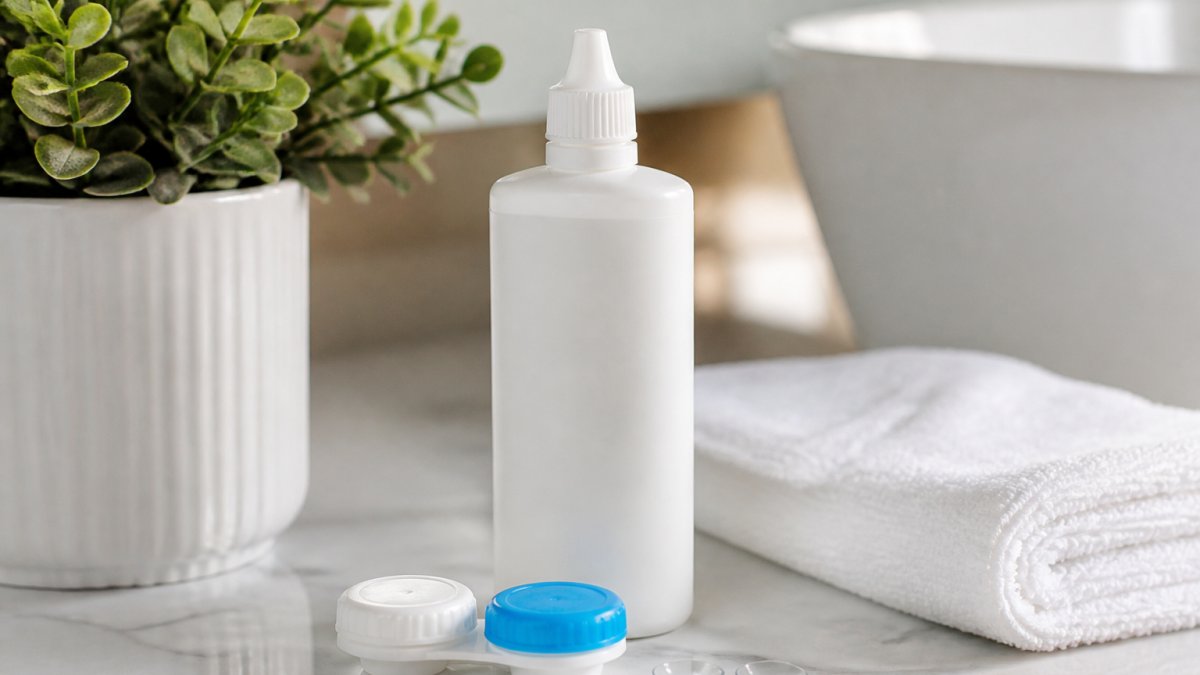
Saline solution for contact lenses is a salt-water rinse, either buffered or unbuffered, and it is not a disinfectant.
Buffered saline maintains a stable pH and suits rinsing and some heat disinfection systems; unbuffered saline is essentially salt and water with no pH control.
Use saline for rinsing. Use a disinfecting solution or a peroxide system for storage. Those are different jobs, and mixing them up is a common mistake.
How to Clean and Store Lenses with Preservative-Free Solution
The routine is short, and the order matters more than the products.
- Wash and dry your hands with soap and a lint-free towel before touching anything.
- Remove one lens and place it in your palm. Never clean lenses over an open drain.
- Apply cleaner or a few drops of solution and rub the lens gently for the time your product instructions specify.
- Rinse thoroughly with sterile solution, not tap water.
- Place the lens in a clean case filled with fresh disinfecting solution. Never reuse yesterday's solution.
- Repeat for the second lens, then close the case and let it sit for the full disinfection time.
- Empty, rinse, and air-dry the case every morning, open side down, on a clean tissue.
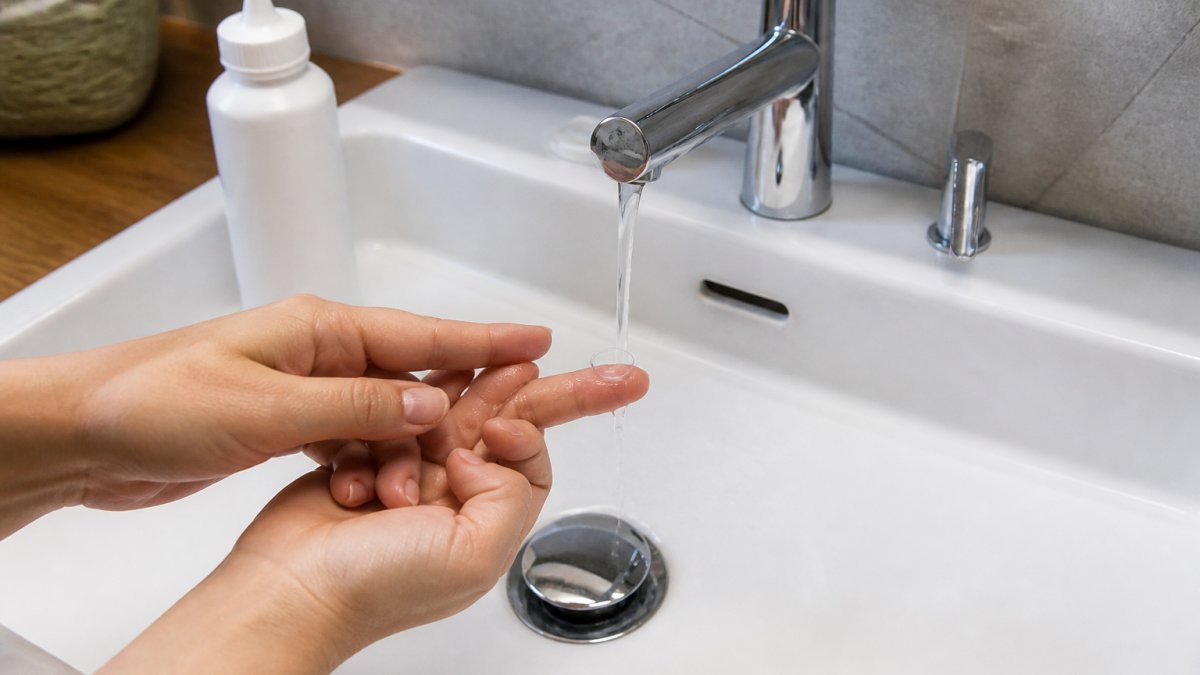
Replace the lens case at least every three months (the CDC). This is not upselling; the case is the most commonly contaminated item in the whole routine.
Safety Limits, Contamination Risks, and When to Call Your Eye Doctor
Preservative-free products carry a real trade-off: without preservatives, multi-dose bottles offer less protection against microorganisms once opened.
Stop lens wear and call us if you notice pain, light sensitivity, discharge, blurred vision that doesn't clear after removal, or a red eye that worsens rather than settles.
| Product Type | Cleans | Disinfects | Stores Lenses | Best For |
|---|---|---|---|---|
| Multipurpose solution | Yes | Yes | Yes | Healthy eyes, simple routine |
| Peroxide system | Minimal | Yes, strong | Yes | Sensitive eyes, preservative-free care |
| Buffered saline | No | No | No | Rinsing only |
| Unbuffered saline | No | No | No | Rinsing only |
| Preservative-free rewetting drops | No | No | No | Mid-day moisture and comfort |
A contact lens fitting is where this gets personal.
If your lenses feel worse at the end of the day than they did a year ago, that's a signal worth acting on rather than tolerating.
Frequently Asked Questions
What are the benefits of preservative-free contact lens solution?
Preservative-free contact lens solution avoids the preservatives, most commonly benzalkonium chloride (BAK), found in many multipurpose solutions. For some wearers this means less stinging on insertion, less irritation over a long day of lens wear, and fewer sensitivity reactions. It is often recommended for people with dry eye, sensitive eyes, or a history of reaction to preserved products. The trade-off is that preservative-free products are usually single-use or require a hydrogen peroxide system, so they cost more per use and demand stricter handling to avoid contamination.
Is preservative-free contact lens solution better for sensitive eyes?
For many people with sensitive eyes, yes. Preservatives can build up in soft lens material and cause stinging, redness, or a gritty feeling, especially with extended wear. A preservative-free option removes that exposure. That said, sensitivity has many causes, including a poor lens fit, protein deposits, or an underlying dry eye condition. If symptoms persist after switching solutions, an eye exam can identify whether the lens material, fit, or tear film is the real problem rather than the solution.
Can preservative-free contact lens solution help with dry eyes?
It can reduce one source of irritation, but it will not cure dry eye. Preservatives may add to the burning and dryness some wearers feel, so removing them often improves comfort during wear. However, dry eye is usually driven by tear film quality, blink rate, screen time, medications, or age. A preservative-free solution plus preservative-free rewetting drops can ease symptoms, but a proper evaluation is the only way to know what is actually causing the dryness and whether a different lens type would help more.
What is the difference between preservative-free solution and saline?
They are not interchangeable. Saline solution for contact lenses is salt water matched to tear film, and it is used for rinsing and storing lenses in some systems. It does not disinfect. Preservative-free contact lens solution in a hydrogen peroxide system cleans and disinfects, which saline cannot do. Never store lenses overnight in plain saline and never use it as your only care step, because bacteria and microorganisms can survive and lead to serious eye infection.