 listicle
Best Brooklyn Optometrist for Contact Lenses: 2026 Guide
Table of Contents
- Top Brooklyn Optometrists Specializing in Contact Lenses
- What to Expect: The Contact Lens Exam & Fitting Process
- Contact Lens Exam Brooklyn Cost: What You'll Pay
- Specialty Contact Lenses Brooklyn: Beyond Daily Disposables
- Types of Contact Lenses: Choosing What Works for You
- Pediatric Optometrist Brooklyn Contact Lenses: Starting Young
- Insurance Coverage & Vision Plans in Brooklyn
- First-Time Contact Lens Wearer: What You Need to Know
Last Updated: July 26, 2026
Finding the best brooklyn optometrist for contact lenses requires understanding what separates a competent eye care provider from one that truly specializes in contact lens fitting and management. At Wilck Schwartz & Novak OD PC, we've spent decades helping patients in Brooklyn achieve clear, comfortable vision through expertly fitted contact lenses. This guide walks you through top optometrists in Brooklyn who excel at contact lens care, what to expect during a fitting appointment, and how to choose the right provider for your vision needs.
The best brooklyn optometrist for contact lenses combines advanced diagnostic technology, extensive experience with complex cases, and genuine commitment to patient comfort. Not every eye doctor excels at this specialty. Some practices treat contact lens fittings as an afterthought to their eyeglass business. Others lack the equipment needed for precise measurements. The optometrists featured below stand apart because they've invested in the right tools, training, and patient-centered approach.
Top Brooklyn Optometrists Specializing in Contact Lenses
1. Wilck Schwartz & Novak OD PC: Advanced Technology & Comprehensive Care Since 1964
Wilck Schwartz & Novak OD PC is the best brooklyn optometrist for contact lenses in Brooklyn for patients seeking comprehensive eye care backed by 60+ years of community trust. Located in Brooklyn, this locally-owned practice uses advanced optometric equipment and modern technologies to deliver precise contact lens fittings alongside routine eye exams and ocular disease management.
What sets them apart is their commitment to early detection and precise treatment. They assess overall eye health thoroughly before recommending contact lenses, ensuring children have visual resources for normal growth and development and adults maintain long-term ocular health. Their warm, inviting office environment puts nervous patients at ease, a critical advantage for first-time contact lens wearers. The practice excels at diagnosing and managing ocular diseases, eye infections, allergies, corneal abrasions, and dry eye syndrome, conditions that frequently complicate contact lens wear. They also offer free LASIK consultations with comprehensive pre- and post-operative care.
2. Contemporary Eyecare: Hard-to-Fit Specialist
Contemporary Eyecare specializes in cases that frustrate other optometrists, patients with keratoconus, severe astigmatism, or a history of failed contact lens fittings. Their approach centers on personalized recommendations rather than one-size-fits-all solutions. They use the latest contact lens technology and conduct precise fitting processes that prioritize comfort and vision quality, with ongoing support for questions and adjustments.
3. VistaSite Eye Care: Precision Fitting for Complex Cases
VistaSite Eye Care operates multiple locations across New York City, including Brooklyn, and has built a reputation for addressing difficult eye issues through comprehensive contact lens solutions. They offer specialized contact lens exams using precise measurements and fitting protocols for complex cases, including soft lenses, hard (gas-permeable) lenses, and solutions for astigmatism, dry eyes, and keratoconus.
4. Atlantic Optical: Fast Service & Specialty Lens Options
Atlantic Optical, located within Atlantic Terminal Mall, combines speed with specialty options. They offer comprehensive eye exams and contact lens fittings alongside daily disposables, monthly lenses, astigmatism corrections, and multifocal options. Their standout offering is Ortho-K (orthokeratology) lenses, which temporarily reshape the cornea overnight, allowing clear vision without daytime correction. One-hour service for prescription eyewear is available in many cases.
5. Cohen's Fashion Optical Brooklyn Heights: Seven-Day Access
Cohen's Fashion Optical in Brooklyn Heights distinguishes itself through extended availability and extensive lens variety. On-site optometrists work seven days a week, accommodating patients with unpredictable schedules. They offer clear and color contact lenses in daily, biweekly, and monthly disposables, plus bifocal and multifocal options. Multilingual eyewear specialists are available, making this practice accessible to diverse Brooklyn communities.
What to Expect: The Contact Lens Exam & Fitting Process
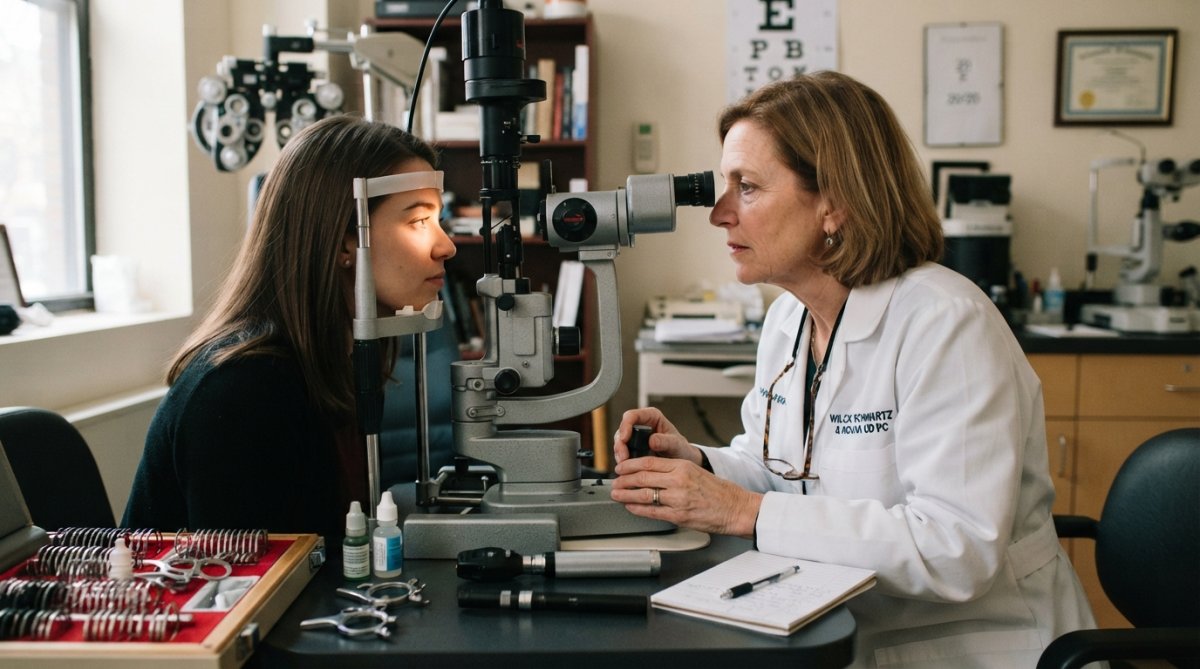
A contact lens exam differs significantly from a standard eye exam. Your optometrist will conduct a thorough refraction to determine your prescription, then perform additional measurements specific to contact lens fitting.
Your optometrist will measure corneal curvature using corneal topography, a non-invasive scan that maps your eye's surface shape. They'll also measure pupil size and overall eye diameter, as contact lens size must match your individual anatomy. During the fitting, trial lenses are placed on your eye to assess comfort, vision clarity, and lens movement. This process typically takes 30-60 minutes; complex cases may require 60-90 minutes.
After the fitting, you'll receive detailed instructions on lens insertion, removal, and daily care. Many practices provide hands-on training to build confidence. You'll schedule a follow-up visit within one to two weeks to ensure the lenses remain comfortable and your vision is stable.
Contact Lens Exam Brooklyn Cost: What You'll Pay
Contact lens exams in Brooklyn typically cost more than routine glasses prescription exams because they involve additional measurements, trial lenses, and follow-up appointments. Many practices bundle the exam fee with the cost of initial contact lens supply or trial lenses.
Insurance coverage varies, some vision plans cover contact lens exams at the same rate as glasses exams, while others charge a separate copay or cover only a portion of the cost. Several Brooklyn practices accept major vision insurance plans, including VSP and EyeMed. Contact your preferred practice directly and ask whether they accept your insurance and offer package pricing that combines the exam, trial lenses, and initial supply.
Specialty Contact Lenses Brooklyn: Beyond Daily Disposables
Brooklyn optometrists increasingly offer specialty contact lenses for patients whose eyes don't fit standard options.
Scleral Lenses for Hard-to-Fit Eyes
Scleral lenses are large-diameter rigid lenses that vault over the cornea and rest on the white of the eye (sclera). They're ideal for patients with keratoconus, severe astigmatism, dry eye syndrome, or corneal scarring. Because scleral lenses don't touch the cornea directly, they reduce irritation and allow the eye to maintain a fluid reservoir behind the lens, providing constant hydration. The fitting process is more complex and requires specialty expertise.
Multifocal & Astigmatism Correction
Multifocal contact lenses address presbyopia, the age-related difficulty focusing on near objects. These lenses contain multiple powers in different zones, allowing clear vision at distance and near. Astigmatism correction in contact lenses is achieved through toric designs, which have different powers in different meridians. Cohen's Fashion Optical and Atlantic Optical both stock multifocal and toric options.
Types of Contact Lenses: Choosing What Works for You
Daily Disposables vs. Monthly & Weekly Lenses
Daily disposable lenses are worn once and discarded, eliminating the need for cleaning solutions and lens cases. They're the most convenient option but cost more than monthly or weekly lenses. Monthly and weekly lenses require daily cleaning with solution and are more economical over time. Weekly lenses occupy a middle ground, offering lower cost than daily disposables with less rigorous cleaning than monthly lenses.
| Lens Type | Cost (Monthly) | Cleaning Required | Best For |
|---|---|---|---|
| Daily Disposables | Higher | None | Convenience-focused, travelers, sensitive eyes |
| Weekly Lenses | Moderate | Daily cleaning | Cost-conscious with consistent care habits |
| Monthly Lenses | Lower | Daily cleaning | Budget-focused, disciplined wearers |
Soft vs. Hard (Gas-Permeable) Lenses
Soft lenses are made from hydrophilic plastics that contain water, making them comfortable for most wearers and easier to insert and remove. However, they can dry out in arid environments or during long screen time and don't correct severe astigmatism as effectively as rigid options.
Hard lenses, also called gas-permeable (GP) lenses, are rigid but oxygen-permeable, allowing your cornea to breathe. They provide sharper vision for many patients and excel at correcting irregular astigmatism and keratoconus. The drawback is a longer adaptation period of 1-2 weeks. Patients with dry eyes or sensitive corneas often find GP lenses more comfortable long-term.
Pediatric Optometrist Brooklyn Contact Lenses: Starting Young
Children and teenagers increasingly wear contact lenses for sports, social confidence, or better peripheral vision than glasses provide. Pediatric optometrists recognize that fitting children requires additional considerations beyond standard adult fitting, including detailed instruction on lens insertion, removal, and hygiene, plus more frequent follow-up appointments.
The best age to start contact lenses is typically 12-14 years old, when children demonstrate the maturity and responsibility needed for daily lens care. Wilck Schwartz & Novak OD PC has extensive experience ensuring children have visual resources for normal growth and development. Daily disposables are often recommended for younger wearers, eliminating the responsibility of nightly cleaning.
Insurance Coverage & Vision Plans in Brooklyn
Vision insurance in Brooklyn typically covers eye exams and may cover contact lens exams, though often with separate copays or limited coverage amounts. Common plans include VSP (Vision Service Plan), EyeMed, and Cigna Vision. Many plans cover a portion of contact lens costs, often a flat allowance of $100-$150 per year.
Medicaid covers vision exams and contact lenses for eligible beneficiaries in New York. Medicare generally does not cover routine eye exams or contact lenses. Before scheduling an appointment, contact your insurance provider to understand your specific coverage and whether the optometrist is in-network.
First-Time Contact Lens Wearer: What You Need to Know
Transitioning from glasses to contact lenses requires adjustment. Your eye needs an adaptation period, typically 5-7 days for soft lenses and 1-2 weeks for gas-permeable lenses. During this time, you may experience mild irritation or slight blurriness that resolves as your eye adjusts.
Start by wearing lenses for a few hours daily, gradually extending wear time as comfort improves. This gradual approach prevents overwhelming your eye and allows you to identify genuine fit issues early. If discomfort persists beyond the adaptation period, contact your optometrist immediately.
Many first-time wearers struggle with insertion and removal initially. Your optometrist will provide hands-on training and practice time in the office. Ask for written instructions or videos you can reference at home. Keep realistic expectations about vision, contact lenses provide excellent vision for most wearers, but some patients experience minor visual trade-offs depending on lens type and fit.
Establish a consistent care routine from day one. If wearing monthly lenses, clean and store them properly every night. If wearing daily disposables, dispose of them immediately after removal. Proper care determines your long-term success with lenses.
Choosing the best brooklyn optometrist for contact lenses means finding a practice that combines advanced diagnostic equipment, specialized expertise in fitting, and genuine commitment to your comfort and vision. Wilck Schwartz & Novak OD PC brings 60+ years of community trust to this mission, using modern technology to assess overall eye health and deliver precise contact lens fittings. Their expertise in diagnosing and managing ocular diseases, combined with their warm, inviting office environment, ensures you receive comprehensive care. Schedule a comprehensive eye exam with Wilck Schwartz & Novak OD PC and discover how expertly fitted contact lenses can transform your daily vision and confidence.
Frequently Asked Questions
How much does a contact lens exam cost at Brooklyn optometrists?
Contact lens exam costs vary by provider and the complexity of your prescription. Pricing depends on the optometrist, whether you need a specialty fitting, and your vision insurance coverage. LensCrafters lists a contact lens fitting starting fee, but independent practices like Wilck Schwartz & Novak OD PC may have different pricing structures. For accurate pricing, contact your chosen Brooklyn optometrist directly or visit their website for current rates.
What makes an optometrist a specialist in hard-to-fit contact lenses?
Specialists in hard-to-fit cases have advanced training in corneal topography, scleral lens fitting, and managing complex eye conditions like keratoconus or astigmatism. They use precision refraction techniques and advanced diagnostic equipment to ensure accurate fitting. Contemporary Eyecare and VistaSite Eye Care in Brooklyn are known for this expertise. A good specialist will conduct thorough eye health assessments and offer multiple lens options tailored to your specific ocular anatomy.
Do I need a separate contact lens exam if I already have a glasses prescription?
Yes, you do need a separate contact lens exam even with a current glasses prescription. A comprehensive contact lens exam includes additional measurements like corneal topography, refraction specific to contact lens wear, and assessment of tear film and ocular health. Your glasses prescription differs from your contact lens prescription because contacts sit directly on your eye. A proper fitting ensures comfort, vision quality, and eye health protection during contact lens wear.
Can children get contact lenses from Brooklyn pediatric optometrists?
Yes, children can wear contact lenses with proper fitting and supervision from a pediatric optometrist. Many Brooklyn practices, including Wilck Schwartz & Novak OD PC, offer pediatric services and can fit contact lenses for children when appropriate. Children are typically good candidates if they can handle lens care responsibly. A pediatric optometrist will assess your child's eye health, maturity level, and vision needs to determine if contact lenses are suitable and recommend the best lens type.
What types of contact lenses are best for astigmatism in Brooklyn?
For astigmatism, toric contact lenses are the standard choice, they're available in daily disposables, weekly, and monthly options. Some patients with moderate to severe astigmatism benefit from rigid gas-permeable (hard) lenses or scleral lenses for sharper vision. A Brooklyn optometrist will perform a refraction and corneal topography to determine which lens type provides the best vision correction and comfort. Specialty contact lenses Brooklyn providers like Contemporary Eyecare and VistaSite Eye Care excel at fitting complex astigmatism cases.
This article was written using GrandRanker