 listicle
Common Vision Problems Affecting School Performance
Table of Contents
- Why Vision Problems Can Derail School Performance
- Common Vision Problems in School-Aged Children
- Signs of Vision Problems in Children: A Symptom-to-Problem Guide
- Myopia and School Performance: When Nearsightedness Affects the Board and Beyond
- School Vision Screening vs Eye Exam: What Parents Need to Know
- What to Expect at a Children's Comprehensive Eye Exam
- Classroom Accommodations While Your Child Awaits Assessment or Treatment
- When to Seek Professional Help for Vision Problems
- Frequently Asked Questions
Last Updated: October 17, 2026
Why Vision Problems Can Derail School Performance
Vision problems affecting school performance rarely announce themselves. A child who cannot see the board copies from a neighbor; a child whose eyes struggle to work together may avoid reading altogether.
Here is what makes this tricky. The American Optometric Association's guidance on children's vision puts it plainly: vision is a learned skill, and school-age children are still building it.
Below, we break down the most common vision problems in school-aged children, what they look like in the classroom, and what parents and teachers can actually do about them.
Common Vision Problems in School-Aged Children
The vision problems that interfere with schoolwork fall into two groups: refractive errors, where the eye cannot focus light properly, and visual skill problems, where the eyes and brain struggle to work together. Both can exist in a child with "perfect" eyesight by school screening standards, which is why a screening pass is not a clean bill of health.
Refractive Errors: Myopia, Hyperopia, and Astigmatism
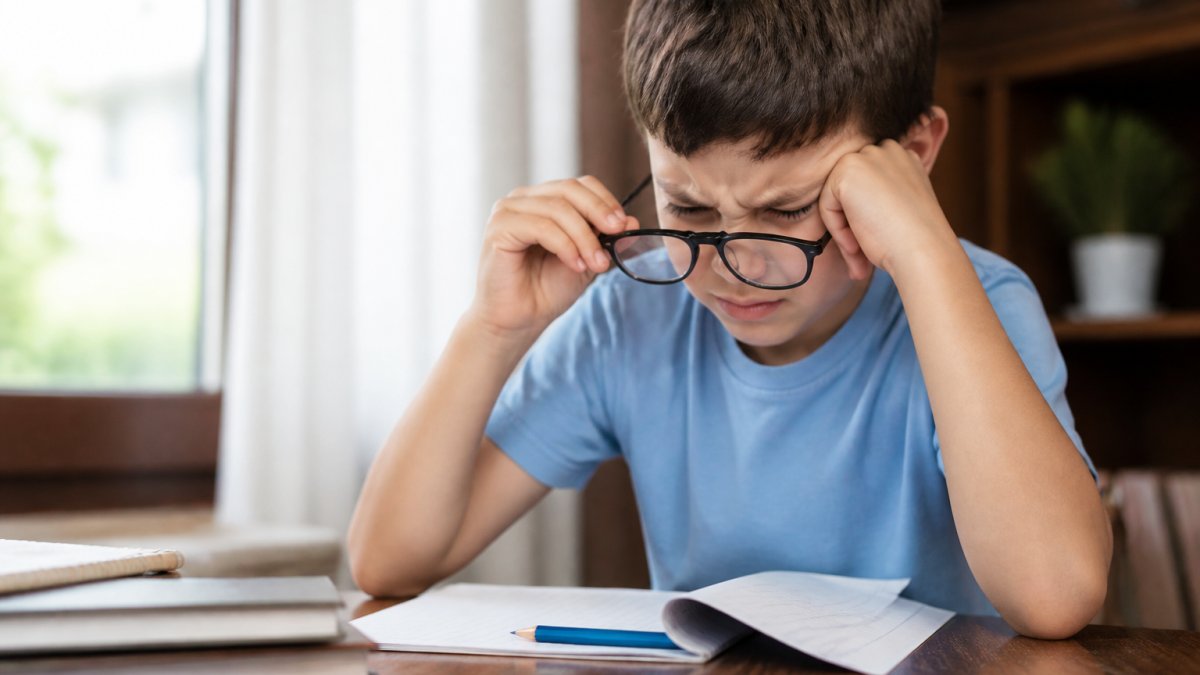
Myopia (nearsightedness) makes distant objects blurry while close work stays sharp. A nearsighted child can read a book comfortably but cannot make out the board, so they squint, lean forward, or quietly disengage.
Hyperopia (farsightedness) is harder to spot. Many children focus through mild hyperopia, and that effort shows up as headaches and fatigue after close work, not obvious blur.
Astigmatism is a curvature irregularity that blurs vision at all distances. It frequently travels with myopia or hyperopia, and uncorrected astigmatism can make letters look distorted or doubled.
Amblyopia (Lazy Eye) and Convergence Insufficiency
Amblyopia is reduced vision in one eye that does not fully correct with lenses. It develops when the brain favors one eye and lets the other weaken. Because the strong eye compensates, amblyopia is easy to miss without a proper exam, and early detection matters because treatment works best in younger children.
Convergence insufficiency is an eye-teaming problem: the eyes do not turn inward smoothly for close work, so reading becomes a physical strain. Children lose their place, skip lines, or push through a page and then complain of headaches.
Signs of Vision Problems in Children: A Symptom-to-Problem Guide
Teachers and parents usually notice the behavior before anyone names the cause. The table below connects common observations to the visual skills that may be involved, but it is a starting point for a conversation with an eye doctor, not a diagnosis.
| What you observe | Likely visual skill involved | What to do |
|---|---|---|
| Squinting, leaning forward, or moving closer to the board | Distance vision (myopia) | Note when it happens; request a comprehensive eye exam |
| Headaches or eye strain after reading | Focusing effort (hyperopia) or eye teaming | Track timing; mention it to the eye doctor |
| Losing place, skipping lines, re-reading | Eye tracking and convergence | Ask about a binocular vision evaluation |
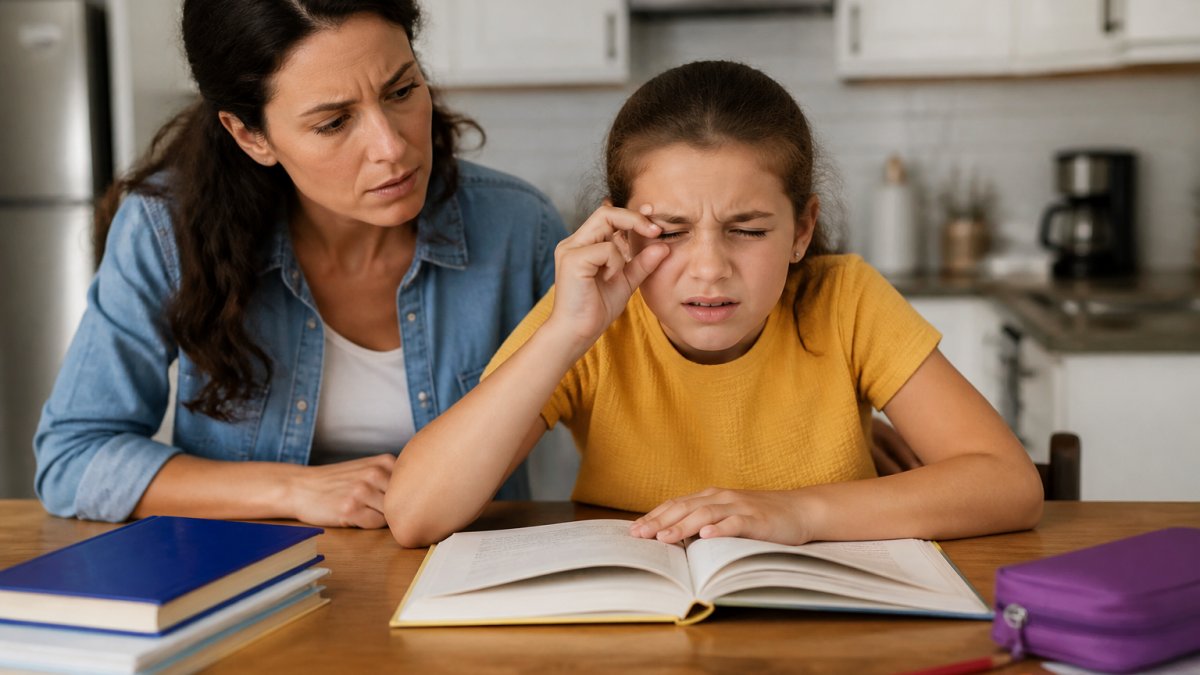
| Rubbing eyes, blinking hard, short attention span | Visual fatigue | Note screen time and reading duration |
| Tilting head or covering one eye | Possible amblyopia or alignment issue | Book an exam promptly |
| Avoiding reading or close work | Any of the above | Rule out vision before assuming motivation |
Age-Specific Signs: What to Watch For at Different Stages
The same visual problem can look different at age 5 and age 15.
Early childhood (ages 3-6): Watch for a child who sits very close to the television, holds books inches from the face, or rubs their eyes during picture-book time.
Elementary school (ages 6-11): Board visibility becomes a daily demand. A child who copies from a neighbor or suddenly stops volunteering answers may be struggling to see the front of the room.
Adolescents (ages 12-18): Older students may compensate quietly by photographing the board, asking friends for notes, or avoiding reading-heavy classes.
What Symptoms Can and Cannot Tell You
A symptom is a clue, not a conclusion. Losing place while reading can point to an eye-teaming problem, but it can also reflect attention or comprehension issues.
Children with visual skill problems are often described as "not trying hard enough" or "easily distracted" before anyone considers their eyes, a label that can follow a child for years.
Myopia and School Performance: When Nearsightedness Affects the Board and Beyond
Nearsightedness is the most visible of these problems because it directly hits board visibility. A nearsighted child misses the front of the room, copies the wrong homework assignment, and falls behind on material delivered at a distance.
Myopia also tends to progress during school years, so last year's prescription may not be enough now.
Screen time complicates the picture. Long stretches of close work are associated with myopia progression in children, and the National Eye Institute's information on myopia notes that nearsightedness is increasing among children.
School Vision Screening vs Eye Exam: What Parents Need to Know
A school vision screening is a quick distance chart test designed to flag obvious problems.
Screenings miss things. They typically do not test near vision carefully, do not assess eye teaming, and cannot detect amblyopia reliably because a child can read the chart with their stronger eye.
If your child complains of headaches during reading despite a clean screening, that complaint is the real signal. Ask for a full exam rather than waiting for the next screening cycle.
What to Expect at a Children's Comprehensive Eye Exam
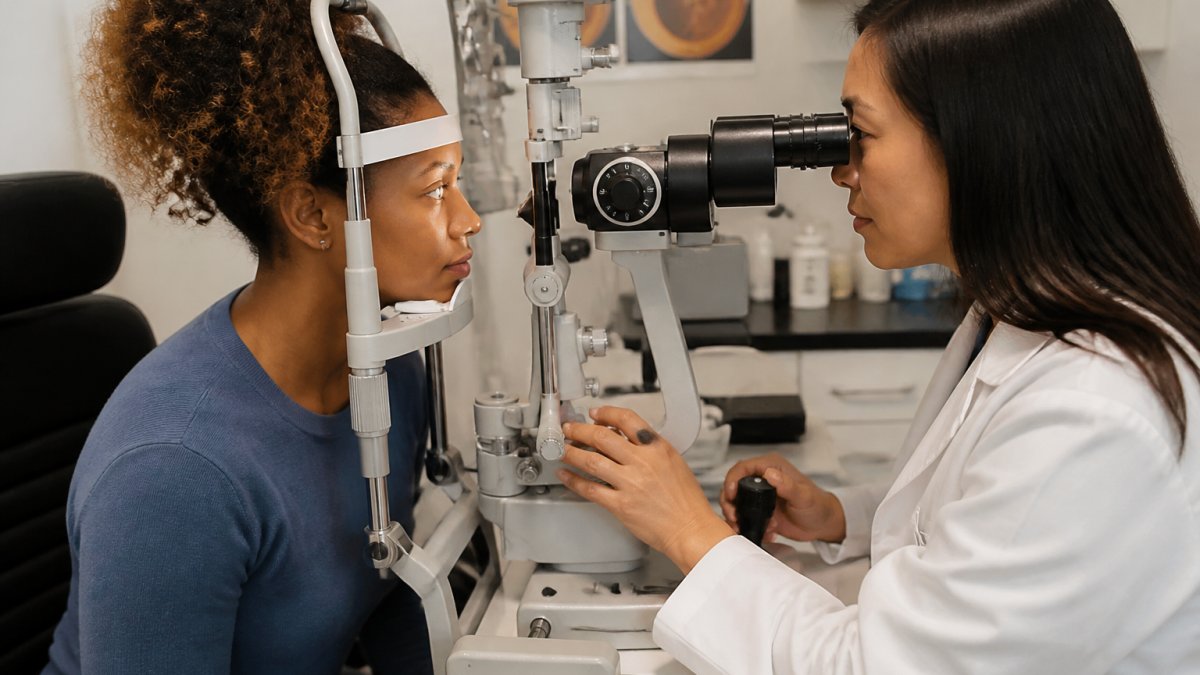
A children's comprehensive eye exam checks more than sharpness: distance and near vision, refraction, eye health, and binocular vision skills such as eye teaming and tracking.
Bring specific examples: when headaches happen, how long reading sessions last before trouble starts, and whether the board or the book is the bigger problem. Those details steer the evaluation.
We built our pediatric exams around early detection because the earlier a problem is identified, the more options exist.
Classroom Accommodations While Your Child Awaits Assessment or Treatment
Waiting for an exam or glasses does not mean waiting to help. Teachers can make small changes that reduce strain and reveal what the child actually needs.
Practical Adjustments Teachers Can Make Now
- Seat the child closer to the board, and check that the seat allows a straight view without turning.
- Provide printed copies of board notes so the child is not copying from a distance.
- Allow extra time for close work and permit breaks during long reading assignments.
- Reduce glare from windows and adjust screen brightness for computer tasks.
- Pair the child with a note-taking partner for lessons delivered at the back of the room.
- Use larger print or high-contrast materials for worksheets when possible.
- Give verbal instructions alongside written ones so the child is not relying on distant text alone.
These are bridges, not solutions. They keep a child from falling behind while the real cause gets addressed, and they give you useful information: if closer seating helps, distance vision is likely part of the story. If breaks during reading help but seating does not, the issue may be near-work stamina or eye teaming.
When Access Is the Barrier: What Families Can Do
Cost, insurance, transportation, and appointment availability can all delay care. If any are obstacles, ask the school about resources before assuming nothing is available.
- School nurse or health office: Ask whether the school has a list of local eye care providers that offer sliding-scale fees or accept the family's insurance.
- School social worker or counselor: These staff often know about community programs that cover vision care for students who qualify.
- Vision screening follow-up: If the school screening flagged a concern, ask for the written result and bring it to the exam. Some schools track follow-up and can help coordinate.
- Insurance and benefits: Check whether the child's coverage includes a pediatric eye exam; many plans cover annual exams for children even when adult coverage is limited.
- Community health centers: Federally qualified health centers often provide eye care on a sliding scale, and school staff can usually point families toward them.
If glasses are prescribed but the family cannot afford them, say so directly to the school and the eye doctor. Some practices have programs for children's glasses, and schools sometimes have funds or donated frames. The goal is to keep the child from going without correction because of a cost barrier no one asked about.
Coordinating With School Staff: A Short Script
You do not need a formal plan to start the conversation. A brief note to the teacher can cover what you have noticed and what you are doing about it: "We have noticed that [child] squints at the board and complains of headaches after reading.
That message does three things: it tells the teacher the behavior has a possible cause, asks for a specific temporary adjustment, and sets up a follow-up loop.
What Accommodations Are Not
Classroom adjustments do not replace an eye exam or treat a vision problem. They buy time and reduce strain while the child gets proper care. If a child needs glasses or vision therapy, no seating chart will substitute. The goal is to get the child off the bridge and into the right care as soon as possible.
When to Seek Professional Help for Vision Problems
Book an exam if your child shows any of the signs above, if a teacher raises a concern, or if there is a family history of myopia, amblyopia, or eye turns, do not wait for a school screening to confirm it.
Some situations need urgent attention rather than a routine appointment: sudden vision loss, a visible eye injury, or an eye infection with pain or discharge.
A common mistake is treating vision as a once-a-year checkbox. Children change fast. If something feels off between exams, say so.
Frequently Asked Questions
What are the most common vision problems in school-aged children?
The most common vision problems in school-aged children include refractive errors such as myopia (nearsightedness), hyperopia (farsightedness), and astigmatism. Other issues like amblyopia (lazy eye) and convergence insufficiency also affect learning. Myopia makes distant objects blurry, hyperopia affects close-up tasks, and astigmatism distorts vision at all distances. These problems can interfere with reading, seeing the board, and maintaining attention in class.
Can a school vision screening detect all vision problems?
No, a school vision screening is not designed to catch every vision problem. Screenings typically check distance acuity only and may miss issues like hyperopia, astigmatism, convergence insufficiency, and amblyopia. They also do not assess eye health or how well the eyes work together. A comprehensive eye exam by an optometrist is needed to evaluate all aspects of vision and eye health, especially if a child shows signs of difficulty.
How can I tell if my child's vision is affecting their school performance?
Watch for signs such as squinting, holding books very close, complaining of headaches or eye strain, losing place while reading, or avoiding close work. Teachers may notice inattentiveness or difficulty copying from the board. If your child's grades drop or they seem frustrated with reading, a vision problem could be the cause. A comprehensive eye exam can rule out or confirm vision issues and guide next steps.
When should a child have a comprehensive eye exam?
Children should have a comprehensive eye exam at least once before starting school, and then every one to two years unless a doctor recommends more frequent visits. If you notice signs of vision problems or if a school screening flags an issue, schedule an exam promptly. Children with a family history of vision problems or those who wear glasses should be seen more often. Early detection supports learning and development.
Not sure whether your child's struggle is vision or something else? Wilck Schwartz & Novak OD PC provides comprehensive children's eye exams using advanced optometric equipment, with a focus on early detection and clear answers for parents. We assess overall eye health, check the visual skills that classroom learning depends on, and walk you through what we find. Schedule an appointment and get your child's vision questions settled before the next school term.