 how-to
How Long Does an Eye Exam Take With Dilation?
Table of Contents
- How Long Does an Eye Exam Take With Dilation? A Complete Timeline
- What to Expect During a Comprehensive Eye Exam
- How Long Does Eye Dilation Last? A Phase-by-Phase Breakdown
- Can I Drive After an Eye Exam With Dilation?
- Recovery Hacks: How to Manage the Rest of Your Day
- Frequently Asked Questions
Last Updated: September 10, 2026
How Long Does an Eye Exam Take With Dilation? A Complete Timeline
A comprehensive eye exam with dilation typically takes 60 to 90 minutes from check-in to check-out. That includes the pre-exam testing, the doctor's assessment, and the 20 to 30 minutes you'll spend waiting for mydriatic drops to take full effect. We schedule dilated exams with this full window in mind so nobody feels rushed through the process.
Most people are surprised by that number. They expect a quick 20-minute visit and then wonder why they're still sitting in the waiting room 40 minutes later. The answer isn't inefficiency. It's biology. Your pupils need time to open fully before the doctor can get a clear view of your retina.
The Total Appointment: 60 to 90 Minutes
The full appointment breaks into four phases:
| Phase | Time | What Happens |
|---|---|---|
| Pre-exam testing | 10-15 min | Visual acuity, intraocular pressure, autorefraction |
| Dilation wait | 20-30 min | Mydriatic drops take effect |
| Doctor's exam | 15-20 min | Retinal examination, slit lamp, clinical assessment |
| Check-out | 5-10 min | Discussion, prescription, scheduling |
The dilation wait is the variable that catches people off guard. Everything else runs on a predictable schedule.
The Exam Itself: 30 to 45 Minutes
Once your pupils are fully dilated, the doctor's portion moves quickly. A retinal examination takes 10 to 15 minutes. The slit lamp evaluation adds another 5 to 10 minutes. If you're also being fitted for contacts or discussing a new prescription, add 10 minutes.
The actual hands-on time with your eye doctor is shorter than most patients expect. The waiting is what fills the calendar.
What to Expect During a Comprehensive Eye Exam
A comprehensive eye exam with dilation follows a set sequence, and knowing what comes next makes the whole visit less stressful. Here's the order of operations.
Step 1: Pre-exam testing (10-15 minutes) A technician measures your visual acuity (the letter chart), checks intraocular pressure for glaucoma screening, and may run autorefraction to estimate your prescription.
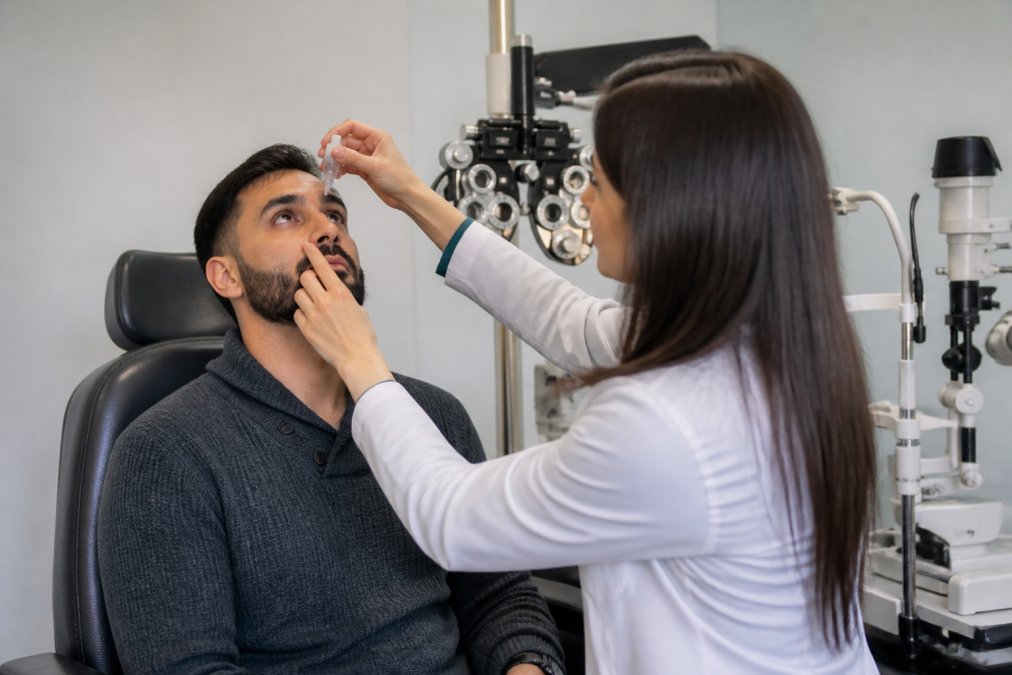
Step 2: Dilation drops (2 minutes, then 20-30 minutes of waiting) The doctor or technician places mydriatic drops in each eye. These relax the ciliary muscle and the iris sphincter, which widens your pupil.
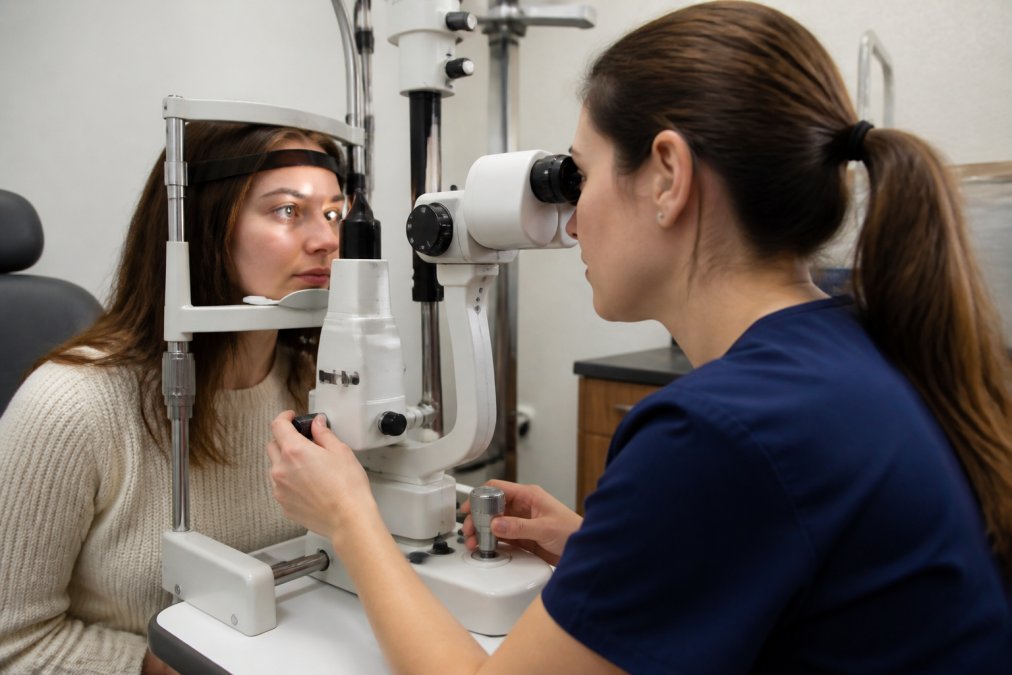
Step 3: The doctor's examination (15-20 minutes) Your optometrist or ophthalmologist uses a slit lamp and a handheld lens to examine the retina, optic nerve, and blood vessels. This is the part that requires dilation.
Step 4: Discussion and prescription (5-10 minutes) You'll review findings, get an updated prescription if needed, and schedule follow-up care.
According to the National Eye Institute's guide to dilated eye exams, dilation is essential because it gives the doctor a wide, unobstructed view of the back of the eye, where conditions like macular degeneration and diabetic retinopathy first appear.
How Long Does Eye Dilation Last? A Phase-by-Phase Breakdown
Dilation effects last anywhere from 4 to 24 hours, depending on which drops are used and how your body responds. The peak effect hits around 30 minutes after instillation and begins fading gradually after that.
How Long Dilation Drops Take to Work
Standard mydriatic drops start working within 15 to 30 minutes. Full dilation is usually reached by the 30-minute mark. If your doctor uses a stronger agent, onset can be faster but recovery takes longer.
Factors That Change the Timeline
Several things affect how long your pupils stay wide:
- Drop strength: Stronger agents last longer
- Eye color: Lighter irises tend to dilate faster and recover faster
- Age: Older patients often experience slower pupillary response and longer recovery
- Medications: Some drugs interact with mydriatics and extend the effect
A common mistake is assuming you'll be back to normal in an hour. For most people, near vision stays blurry for several hours. Plan accordingly.
According to the American Academy of Ophthalmology's patient resources, the effects of standard dilating drops usually wear off within 4 to 6 hours, though some patients report residual light sensitivity into the next morning.
Can I Drive After an Eye Exam With Dilation?
No. You should not drive yourself home after a dilated eye exam, and most eye care practices will tell you so before the drops go in. The reason is mechanical, not cautious: mydriatic drops paralyze the iris sphincter and the ciliary muscle, so your pupil can't constrict in bright light and your lens can't shift focus to near objects. That combination degrades three things you need behind the wheel, glare tolerance, depth perception, and the ability to read a dashboard or GPS at arm's length.
Why Dilation Impairs Driving
- Glare and halos. An undilated pupil is roughly 2 to 4 millimeters wide in daylight. A fully dilated pupil can reach 7 to 8 millimeters, letting in far more light. Oncoming headlights, sun glare, and even bright storefronts produce halos and starbursts.
- Depth perception. Blur and unequal pupil response between eyes make it harder to judge following distance and lane position.
- Near vision. Reading your speedometer, mirrors, or a phone mount requires the ciliary muscle your drops have temporarily shut down.
- Reaction time. Even mild light sensitivity slows how quickly you respond to brake lights and pedestrians.
How Long Before You Can Drive Safely
For standard drops like tropicamide, most people shouldn't drive for at least 4 to 6 hours. If your doctor used a stronger agent such as cyclopentolate or a combination drop, plan on 6 to 24 hours. The practical test isn't how you feel, it's whether you can read a text message at arm's length and look at a bright light without squinting. If either fails, you're not ready.
If You Drove Yourself Anyway
It happens. If you arrived alone and the doctor dilates you, you have three realistic options:
- Wait it out in the office or lobby. Bring a book, a charged phone, and sunglasses. Most practices will let you sit until your near vision returns.
- Call a rideshare or taxi. This is usually the fastest fix. Have the app installed and a payment method saved before your appointment.
- Call a friend or family member. Give them a heads-up the morning of your visit so they're not surprised by a midday request.
Plan Ahead Before Your Appointment
The simplest fix is to arrange transportation before you leave home. If you're booking a dilated exam, ask the scheduler whether dilation is planned, some visits, like a simple refraction or contact lens check, may not require it. If dilation is on the schedule, treat the appointment like a procedure: no driving, no tight deadlines afterward, and a ride confirmed in advance.
Recovery Hacks: How to Manage the Rest of Your Day
Recovery from dilation is mostly about managing two symptoms, light sensitivity and blurred near vision, until the drops wear off. The tips below go beyond "bring sunglasses" and address the practical logistics of the hours after your appointment, including what to do if you have to work, study, or parent through it.
Light Sensitivity: What Actually Helps
- Wrap-around sunglasses, not fashion frames. The goal is blocking light from the sides and top, not just the front. Polarized lenses cut glare off windshields and pavement; a dark tint alone doesn't.
- A hat with a brim. A baseball cap or wide-brim hat shades the eyes from overhead light that sunglasses miss.
- Dim your environment. Lower the blinds, switch off overhead fluorescents, and use lamps instead. If you're in an office, a window seat facing away from the sun is better than a desk under a bright panel.
- Blue light and screens. Screen brightness is the bigger issue than blue light itself. Turn your phone and monitor to their lowest comfortable brightness and enable night mode or a warm color temperature if your device has it.
Blurred Near Vision: What to Skip and What to Do Instead
Near vision is the last thing to return. For most people it's blurry for 4 to 6 hours with standard drops, and longer with stronger agents. During that window:
- Skip reading, spreadsheets, and detailed close work. You'll strain and get a headache.
- Skip driving and power tools. See the driving section above.
- Do low-focus tasks. Listening to a podcast, taking a walk in shade, light errands, or a phone call are all fine.
- Use lubricating drops if your eyes feel gritty. Preservative-free artificial tears are gentler if you're using them more than a few times.
- Rest your eyes. Closing them for 10 to 15 minutes reduces the strain from trying to focus through a dilated pupil.
Work and School After a Dilated Exam
This is the part most guides skip. Whether you can return to work or class depends on what the day requires:
- Screen-heavy jobs (software, design, accounting, customer support): Plan to take the afternoon off or work from home with reduced hours. Reading email and code at close range is the hardest task to do while dilated.
- Driving or operating machinery: Not an option until your vision clears. This includes delivery, warehouse, and field roles.
- Meetings and calls: Usually fine. Audio-only work is the easiest to do while dilated.
- Students: Avoid scheduling a dilated exam before a test, a lab, or a reading-heavy class. If you must, sit near the front and ask for printed materials in large type.
- Parents and caregivers: Arrange backup for school pickup and any activity that requires driving or close supervision.
The cleanest strategy is to book dilated exams for late afternoon or the end of the workday, then go straight home. If your employer offers flexible hours, use them.
Age and Eye Color Change the Timeline
Recovery isn't the same for everyone. Two factors matter most:
- Age. Pupillary response slows with age, and the ciliary muscle loses flexibility. Patients over 60 often need a full day, not just an afternoon, before near vision returns to normal. Patients in their 20s and 30s typically bounce back in 4 to 6 hours.
- Eye color. Lighter irises (blue, green, hazel) tend to dilate faster and recover faster than darker irises (brown, dark brown). The difference is usually measured in an hour or two, not a full day, but it's real.
- Medications and health conditions. Some drugs interact with mydriatics and extend the effect. Tell your doctor about anything you take, including over-the-counter cold and allergy medications.
A Quick Recovery Checklist
- Sunglasses (wrap-around, polarized) and a hat
- A ride home confirmed before the appointment
- A low-focus plan for the next 4 to 6 hours
- Preservative-free artificial tears
- A dim room and a charged phone
- No driving, no close work, no bright screens until near vision returns
If you're managing conditions like glaucoma or macular degeneration, your doctor may recommend more frequent dilated exams for ongoing monitoring. The CDC's vision health resources note that early detection through regular dilated exams significantly improves outcomes for age-related eye conditions.
Frequently Asked Questions
Can I drive 2 hours after eye dilation?
It depends on how your eyes respond. Dilation typically lasts 4 to 6 hours, and during that window your near vision stays blurry and you may be sensitive to light. Two hours after the appointment, most people still should not drive. Arrange a ride, use a rideshare, or take public transit until your vision clears and you can read a street sign comfortably.
How long does it take for eye dilation drops to work?
Mydriatic drops usually start working within 15 to 30 minutes. The doctor will often have you wait in a dim room while your pupils open fully before the retinal examination begins. If your pupils are slow to respond, the wait can stretch closer to 45 minutes, which is one reason the full appointment runs 60 to 90 minutes.
What should you not do after eye dilation?
Skip driving, cycling, or operating machinery until your vision returns to normal. Avoid rubbing your eyes, since the drops can leave them feeling gritty and irritated. Wear sunglasses outdoors, even on cloudy days, because light sensitivity can linger for hours. If you have work that requires sharp near vision, such as detailed reading or soldering, plan it for the next day.
Is it necessary to have someone drive me home after an eye exam?
For most patients, yes. Blurred vision and depth perception changes make driving risky for several hours after dilation. Even if you feel fine, your pupillary response is still slowed, which affects how quickly you react to glare and changing light. Bringing a driver, or planning a rideshare or transit route in advance, is the safest approach.
Dilation adds time to your appointment, but it's the part of a comprehensive eye exam that catches problems before they become serious. If you're due for a dilated exam, schedule with Wilck Schwartz & Novak OD PC. Our team uses advanced diagnostic equipment to examine your retinal health thoroughly, manages everything from routine exams to urgent eye care, and has served Brooklyn families since 1964. Get started with Wilck Schwartz & Novak OD PC and get a clear picture of your eye health.