 how-to
How to Choose the Right Contact Lens Solution
Table of Contents
- How to Choose the Right Contact Lens Solution: Quick Comparison
- Multipurpose vs Hydrogen Peroxide Contact Solution: Key Differences
- How to Clean Contact Lenses Properly
- Signs of Contact Lens Solution Sensitivity
- Choosing a Solution Based on Your Lens Type
- Preservative-Free Options for Dry Eye and Sensitive Eyes
- Cost, Sustainability, and Travel: Practical Considerations
- Frequently Asked Questions
Last Updated: September 11, 2026
How to Choose the Right Contact Lens Solution: Quick Comparison
Choosing the right contact lens solution means matching the formula to your lens material and eyes. Soft lens wearers generally do well with a multipurpose solution, while sensitive eyes or heavy protein buildup often need a hydrogen peroxide system. This guide from Wilck Schwartz & Novak OD PC covers the differences, the cleaning steps most people skip, and the warning signs a solution isn't working.
The short version: saline rinses but does not disinfect. A multipurpose bottle cleans, rinses, disinfects, and stores in one step. A peroxide system does the deepest clean but needs six hours of neutralization before the lens touches your eye (the FDA). Pick wrong and you risk irritation at best, infection at worst.
| Solution Type | What It Does | Neutralization Time | Best For |
|---|---|---|---|
| Multipurpose | Cleans, rinses, disinfects, stores | None | Most soft lens wearers |
| Hydrogen peroxide | Deep cleans, disinfects | 6 hours minimum | Sensitive eyes, protein buildup |
| Saline | Rinses only | None | Rinsing after cleaning |
| RGP-specific | Cleans, conditions rigid lenses | None | Rigid gas permeable lenses |
Multipurpose vs. Hydrogen Peroxide: Which Type Fits Your Routine
Multipurpose solutions suit wearers who want one bottle and a two-minute routine; peroxide systems suit those who will commit to a six-hour soak and a special case. The trade-off is convenience versus depth of clean.
Saline vs. Disinfecting Solution: They Are Not Interchangeable
Saline is a sterile saltwater rinse; disinfecting solution kills microorganisms. Storing lenses in saline alone leaves them vulnerable to biofilm and infection, which is why every major eye care body treats them as separate products.
Multipurpose vs Hydrogen Peroxide Contact Solution: Key Differences
The core difference between a multipurpose and hydrogen peroxide contact solution is the disinfecting agent. Multipurpose formulas rely on preservatives such as polyhexanide to clean and disinfect in one bottle. Peroxide systems use hydrogen peroxide, which breaks down into saline during neutralization, leaving no preservative residue.
That matters for two groups: people with preservative sensitivity and people who build protein deposits quickly. Peroxide cleans more thoroughly because bubbling lifts deposits off the lens surface; multipurpose formulas trade some depth for speed and simplicity.
A common mistake is assuming peroxide works like a multipurpose soak. Drop a lens into the case and insert it before neutralization finishes, and you're putting peroxide directly on your cornea. That burns.
The FDA guidance on contact lens care products classifies these solutions by their disinfection claims, which is why a saline bottle never carries the same labeling as a disinfecting solution.
How to Clean Contact Lenses Properly
Cleaning contact lenses properly takes about two minutes and follows the same sequence every time: wash, rub, rinse, disinfect, store. Skipping the rub is the most common shortcut, and it's the one that lets deposits and biofilm accumulate.
Here's the routine that works:
- Wash your hands with soap and water, then dry them with a lint-free towel.
- Remove one lens and place it in your palm.
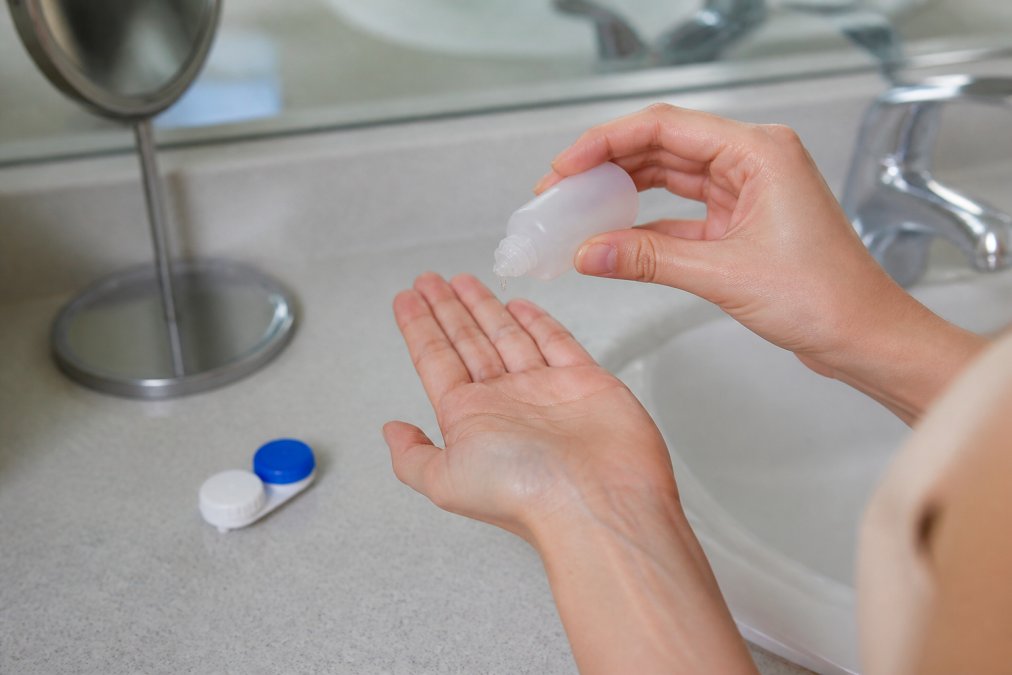
- Apply solution and rub the lens gently with your index finger for several seconds on each side.
- Rinse the lens thoroughly with fresh solution, never tap water.
- Place the lens in a clean case filled with fresh solution and close it.
- Repeat with the second lens, then empty and air-dry the case.
The Rub and Rinse Method Explained
The rub and rinse method is the manual step no shortcut can replace. Even no-rub formulas benefit from a light rub, because friction removes loosened deposits that chemistry alone leaves behind. Rub the lens in your palm, not between your fingers, to avoid pinching or tearing.
Lens Case Hygiene: The Step Most Wearers Skip
Lens case hygiene is where most wearers fall short. A case that never gets rinsed becomes a reservoir for biofilm, and every lens stored in it picks up contamination. Empty it after each use, rinse with fresh solution, air-dry upside down with the caps off, and replace it every few months.
Signs of Contact Lens Solution Sensitivity
Signs of contact lens solution sensitivity usually appear within minutes to hours of inserting a lens: burning, stinging, redness, excessive tearing, or a gritty feeling that doesn't settle. These reactions often trace back to preservatives such as thimerosal or polyhexanide, or to a lens that wasn't fully neutralized.
Watch for these symptoms:
- Burning or stinging right after insertion
- Persistent redness or irritation that lasts beyond a few minutes
- Itching, swelling, or a feeling of hypersensitivity
- Blurred vision or a sensation that something is stuck under the lid
An allergic reaction can build over time, so a solution that worked for months can suddenly cause trouble. If symptoms persist after you remove the lens, stop wearing it and see an eye doctor, corneal inflammation and eye infection share symptoms, and only an exam can tell them apart.
Choosing a Solution Based on Your Lens Type
Your lens material narrows the field fast. Soft and rigid gas permeable lenses require different chemistry, and the wrong one can damage the lens or irritate your eye. The table below is a starting point, but the mechanism behind each product matters more than the price tag.
Soft Contact Lenses
Soft contact lenses work with either a multipurpose solution or a hydrogen peroxide system. Daily wearers who want simplicity prefer multipurpose formulas, while silicone hydrogel wearers and anyone with heavy deposits often get better results from peroxide.
| Product | Starting Price | Key Feature | Best For |
|---|---|---|---|
| Biotrue Multi-Purpose | $12.99 | Matches tear pH, 20-hour hydration | All-day comfort seekers |
| Clear Care | $15.49 | Peroxide clean, preservative-free | Sensitive eyes, protein buildup |
| Opti-Free Puremoist | $13.99 | HydraGlyde moisture matrix | Dryness during the day |
| RevitaLens Ocutec | $11.49 | Broad-spectrum disinfection | Silicone hydrogel lenses |
| Renu Advanced | $9.99 | Triple-disinfectant formula | Budget-conscious daily wearers |
| Equate Multi-Purpose | $5.98 | Basic clean and disinfect | Cost-first shoppers |
Here is what the marketing copy leaves out. Biotrue's pH match to natural tears reduces insertion sting, but it still contains preservatives, so it won't solve a true preservative sensitivity. Clear Care neutralizes into a saline-like solution inside its special case, leaving no residue; the trade-off is the six-hour minimum soak and replacing the case on schedule or the neutralization disc stops working. Opti-Free Puremoist's wetting agent binds water to the lens surface, helping silicone hydrogel wearers who feel dryness by mid-afternoon. RevitaLens Ocutec is formulated around silicone hydrogel's higher oxygen permeability. Renu Advanced and store brands cover the basics, clean, rinse, disinfect, store, without comfort additives, fine for a wearer with no sensitivity and a simple routine.
A quick way to decide: if your lenses feel fine all day and you have no reaction history, multipurpose is the efficient choice. If your eyes sting, dry out, or build deposits quickly, the preservative-free depth of peroxide is usually worth the extra step.
Rigid Gas Permeable Lenses
Rigid gas permeable lenses need a dedicated RGP solution. Boston Simplus Multi-Action, for example, cleans, disinfects, and conditions in one bottle and is formulated specifically for these lenses. Multipurpose soft lens solutions are not a substitute and can leave an RGP surface unwettable.
The reason is surface chemistry. RGP lenses are rigid plastics that rely on a conditioned, water-attracting surface to stay comfortable against the cornea, and RGP solutions deposit a conditioning layer that keeps that surface wettable between blinks. Soft lens multipurpose solutions are built to penetrate a hydrogel matrix, not coat a rigid surface, so they can strip the conditioning layer and leave the lens dry and scratchy. If you wear RGPs, buy the RGP bottle, the categories are not interchangeable.
Preservative-Free Options for Dry Eye and Sensitive Eyes
Preservative-free options are the first thing to try when your eyes sting, dry out, or react to every bottle you buy. Hydrogen peroxide systems like Clear Care and PeroxiClear deliver deep disinfection without preservatives once neutralization is complete, suiting chronic dry eye and sensitive corneas.
The catch is the routine: peroxide requires a minimum six-hour soak, so it doesn't fit a wearer who needs a quick turnaround. For daytime discomfort, preservative-free lubricating and rewetting drops maintain the tear film without adding to the preservative load. If dryness persists, that's a fitting and eye health conversation, not a product-shopping one.
Cost, Sustainability, and Travel: Practical Considerations
Cost and convenience usually decide the final choice, and the spread is real: a store-brand bottle runs a few dollars while a premium peroxide system costs more per unit but often lasts longer per lens. Consider the full cost, not just the sticker.
The Real Cost Math
A multipurpose bottle and a peroxide system aren't priced the same way, and per-lens cost is what matters. A multipurpose bottle typically lasts about a month of daily wear, while a peroxide system's bottle plus its required special case (replaced periodically) runs higher upfront. But peroxide users often skip the separate daily cleaner and rewetting drops that multipurpose users with sensitive eyes buy, so the gap narrows over a year. Daily disposable wearers may not need a disinfecting solution at all, which changes the math entirely. Run the numbers for your own wear schedule before assuming the cheaper bottle is cheaper.
Sustainability: What Actually Gets Recycled
Contact lens solution bottles are typically recyclable plastics, but caps, foil seals, and peroxide cases often aren't accepted curbside. A few moves reduce the waste:
- Buy the largest bottle your routine will use before the expiration date, since plastic per ounce drops sharply with size.
- Check whether your brand runs a take-back or recycling program for cases and packaging, several major lens care brands do, and the details are usually on the package or the brand's website.
- Rinse bottles before recycling; residue can cause a whole load to be rejected.
- Reuse is not an option for solution itself, never top off or dilute, but the case can be cleaned and reused until its replacement interval.
Traveling With Solution: TSA Rules and Peroxide Realities
If you're flying, the Transportation Security Administration's 3-1-1 rule applies to carry-on liquids: containers of 3.4 ounces (100 milliliters) or less, all fitting in one quart-sized bag, one bag per passenger. Contact lens solution counts as a liquid, so a full-size bottle won't clear carry-on screening. Two workarounds: decant into a labeled travel-size bottle (never mix brands in one bottle), or pack the full-size bottle in checked luggage.
Peroxide systems add a complication. The special case is not optional, without it, the peroxide never neutralizes and the lens isn't safe to wear. On a red-eye or short trip, that six-hour soak is awkward, and hotel bathrooms are easy places to lose a case. Multipurpose solution travels more simply: one bottle, no special case, no waiting period. If you wear peroxide at home and travel often, many wearers keep a small multipurpose bottle for trips and switch back at home, but confirm with your eye care professional that both are approved for your lens material.
Whatever you pick, don't mix and match. Combining solutions, or topping off one brand with another, can neutralize the disinfecting agents and leave your lenses unprotected. The CDC guidance on contact lens hygiene is blunt about this: solution should never be reused or mixed.
If your lenses have never fit comfortably or your eyes stay dry despite trying different solutions, that's worth a professional fitting rather than another bottle. Wilck Schwartz & Novak OD PC has served the area since 1964, offering contact lens fittings, dry eye treatment, and emergency care for eye infections and corneal abrasions using advanced optometric equipment. A proper fitting often solves what no over-the-counter solution can.
Frequently Asked Questions
Does it matter which contact lens solution I use?
Yes. Different solutions use different disinfectants, preservatives, and wetting agents, and not all are compatible with every lens material. A hydrogen peroxide solution works differently from a multipurpose solution, and a saline rinse does not disinfect at all. Using the wrong type, or one your eye care provider has not approved for your lenses, can lead to irritation, deposits, or eye infection. Stick with the solution your optometrist recommends for your specific lens type and wear schedule.
Can I switch contact lens solution brands without consulting my optometrist?
It is safer to check first. Some wearers develop sensitivity to specific preservatives, such as thimerosal or polyhexanide, and a switch can trigger redness, stinging, or itching. If you want to try a different contact lens solution, tell your optometrist which one and why. They can confirm it suits your lens material and wear schedule, and they can flag ingredients that may not agree with your eyes.
How do I know if I am having an allergic reaction to my contact lens solution?
Watch for redness, itching, burning, excessive tearing, or a gritty feeling that starts soon after inserting your lenses. These can be signs of contact lens solution sensitivity or an allergic reaction to preservatives. Stop wearing the lenses, keep them out, and contact your eye care provider. Do not try to push through the discomfort or mask it with rewetting drops, because continued exposure can worsen the reaction and, in some cases, affect the cornea.
What is the difference between multipurpose and hydrogen peroxide solutions?
A multipurpose solution cleans, rinses, disinfects, and stores lenses in one bottle, and it usually contains preservatives. A hydrogen peroxide solution uses peroxide to disinfect and then neutralizes it, often in a special lens case over about six hours. Peroxide systems are preservative-free, which some sensitive eyes tolerate better, but they require strict timing and cannot be used to rinse lenses before insertion. Your optometrist can help you decide which fits your routine.