 how-to
How to Improve Reading Posture for Children
Table of Contents
- Why Good Reading Posture Matters for Children
- The Best Reading Position for Children
- Setting Up an Ergonomic Reading Setup for Kids
- How Far Should a Book Be from Your Eyes
- Reading Breaks for Children
- Reducing Neck, Back, and Eye Strain
- When to Seek Professional Eye Care
- Frequently Asked Questions
Last Updated: October 13, 2026
Why Good Reading Posture Matters for Children
Poor reading posture causes chronic neck, back, and eye strain that compounds over years of school and homework, which is why learning how to improve reading posture for children matters so much. (Source: guidelines from the American Academy of Ophthalmology)
When children slouch, lean forward, or hold books too close, their eyes work harder to focus, their neck muscles tense, and their spine curves.
Headaches during or after reading are a warning sign that the eyes are straining, the neck is tense, or the reading distance is wrong.
Teaching proper reading posture now prevents years of discomfort, improves focus, and builds habits that carry into adulthood.
The Best Reading Position for Children
The best reading position for children starts with comfort and alignment: a child sitting comfortably reads longer without fatigue or pain.
The 90-90-90 Seated Posture Rule
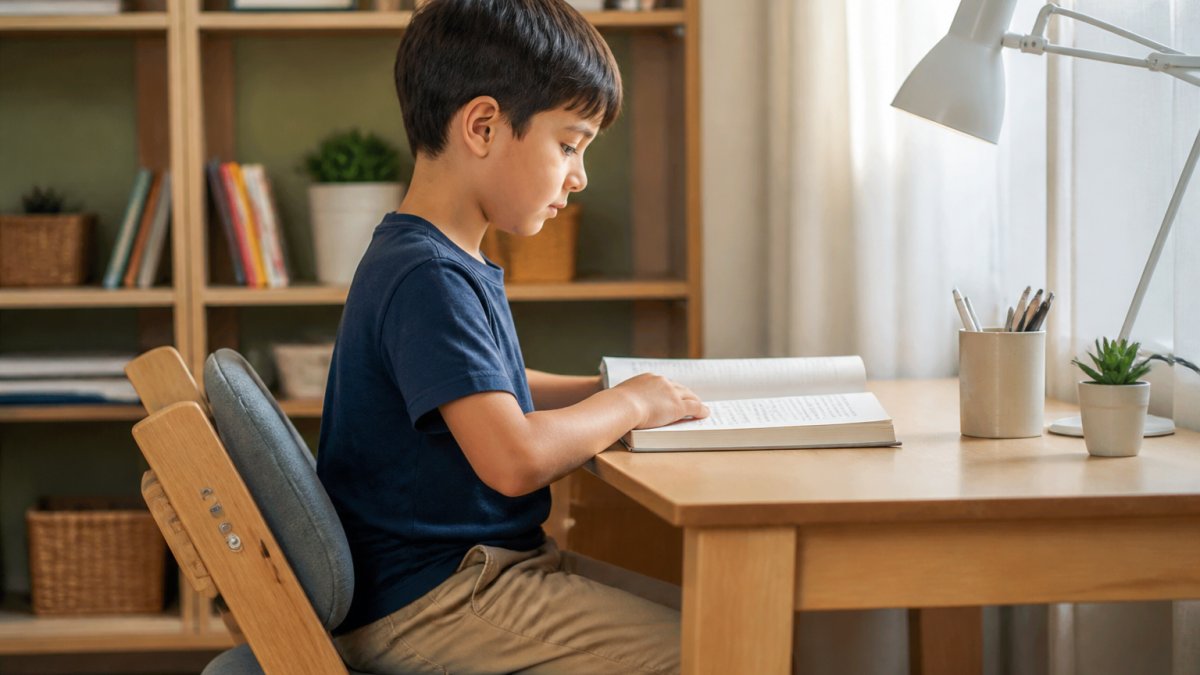
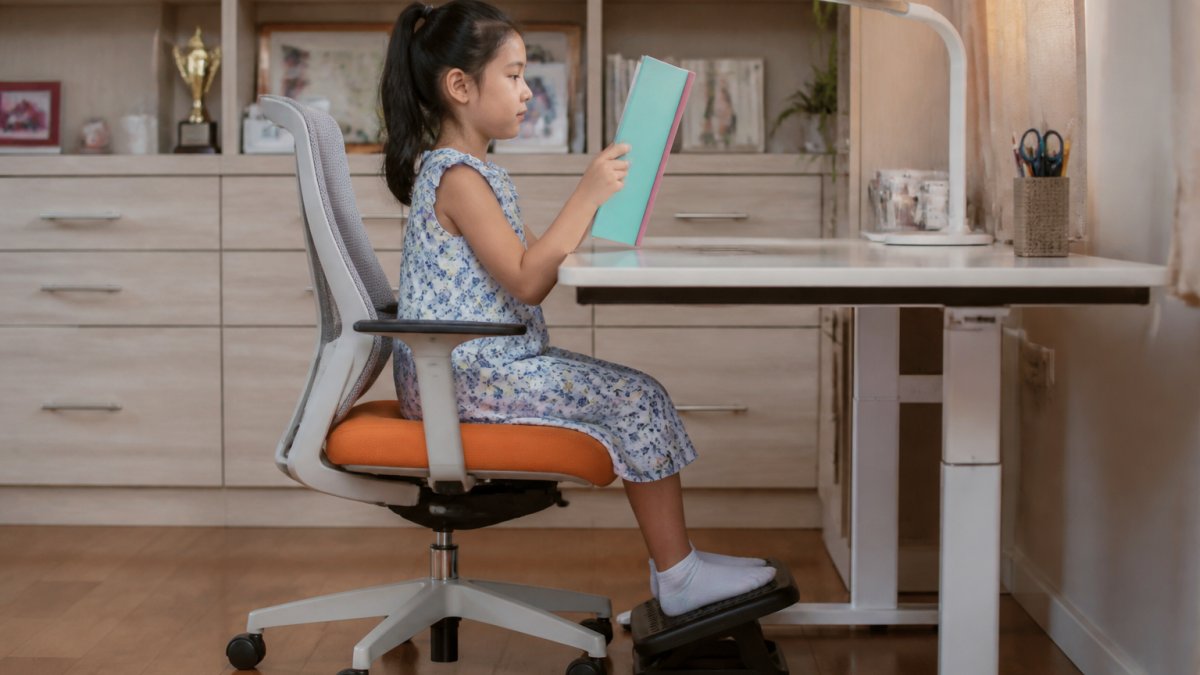
The 90-90-90 rule is the foundation of good reading posture: three 90-degree angles at the hips, knees, and elbows.
Here's what this looks like:
- Hips at 90 degrees: Your child sits upright in the chair. The hips should form a right angle between the torso and thighs.
- Knees at 90 degrees: The knees bend at a right angle. Feet rest flat on the floor or footrest.
- Elbows at 90 degrees: Arms rest comfortably at the sides. Elbows bend at 90 degrees when holding a book.
This distributes weight evenly, keeping the spine neutral so muscles don't work overtime, letting a child read comfortably for 30 minutes or more.
Positioning Elbows, Hips, and Knees
Elbows: Bent elbows keep the book at a manageable distance. Straight, rigid elbows make children hold books too close; tucked elbows round the shoulders forward.
Hips: The hips anchor posture.
Knees: Knees bent at 90 degrees keep feet flat and stable. A chair that's too high leaves feet dangling; too low makes the child lean forward to compensate.
Setting Up an Ergonomic Reading Setup for Kids
An ergonomic reading setup removes barriers to good posture, and understanding how to improve reading posture for children means even a child who knows the correct position won't slip into bad habits if the furniture supports them. There's no single correct setup, chair height, foot support, and book position change as a child grows and depending on where they read.
Match the Setup to Your Child's Size, Not Their Age
Age is a rough proxy; seated measurements matter. A tall 7-year-old and a small 10-year-old may need the same chair height. Use these checkpoints instead of grade level:
- Seat height: When your child sits with hips pushed back, the seat should let their feet rest flat with knees at roughly 90 degrees. If feet dangle, the seat is too high. If knees rise above hip level, it's too low.
- Seat depth: The seat should support the full length of the thigh, with about two to three fingers of space between the back of the knee and the edge of the seat. Deeper seats force children to slouch or perch forward.
- Backrest: The lower back should meet the backrest without a gap. For younger children, a small lumbar cushion or a rolled towel can close the gap until they grow into the chair.
- Desk or table height: With arms relaxed at the sides and elbows bent at 90 degrees, the surface should meet the elbows. If the child has to shrug or reach up, the surface is too high.
Adjustable seats and footrests bridge the growth years better than one "good" chair, since leg length can change by several inches between ages 6 and 12.
Adjusting for Different Reading Situations
Most posture advice assumes a desk.
Floor reading: Cross-legged sitting flattens the lower back curve.
Bed reading: Reading flat on the back strains the neck and shoulders, and on the stomach forces the neck into extension.
Shared reading: Adults often hold the book at adult eye level, too high for the child.
School desks: Classroom desks are sized for the average student, not your child.
Choosing the Right Chair and Reading Surface
A good reading chair for children should support the lower back, let feet rest flat on the floor or footrest, adjust in height as the child grows, and have enough seat depth to support the full thigh.
Desk height matters equally: the surface should meet the elbows when arms are relaxed at the sides. Too low and the child bends forward; too high and the shoulders shrug toward the ears.
Keeping Feet Flat and Supported
Feet flat on the floor or a footrest is non-negotiable. When feet dangle, children shift their weight to stay balanced, creating tension in the legs and lower back. If feet don't reach the floor, add a footrest, a small stool, sturdy box, or purpose-built option, so feet rest flat at a 90-degree angle to the shins.
How Far Should a Book Be from Your Eyes
Distance matters for eye comfort and reading speed. Too close and the eyes strain. Too far and the child leans forward to compensate. (Source: ergonomic design principles for children's furniture)
Maintaining a Comfortable Reading Distance
The ideal reading distance for children is about 10 to 12 inches from eyes to page, roughly elbow to fingertips with the arm bent at 90 degrees.
Some children hold books closer because they think they need to see better, often a sign that vision needs checking. If your child consistently holds books much closer than 10-12 inches, schedule an eye exam; it may indicate myopia or another vision issue that glasses or contacts could correct.
Holding a Book at Eye Level
Holding a book at eye level prevents neck strain. When a book sits too low, the head tilts down and the neck bends forward, creating tension and fatigue. The book should sit at roughly eye height when looking straight ahead; a reading stand, cushion, or book holder can achieve this. Eye-level positioning also encourages better posture overall, since the child naturally sits more upright.
Reading Breaks for Children
Reading breaks prevent fatigue and keep posture from deteriorating. Even perfect posture becomes uncomfortable after continuous reading, and children's muscles tire faster than adults' because they're still developing strength and body awareness.
How Often and How Long
There's no single correct number, and rigid rules backfire with kids. A workable starting point:
- Ages 5 to 7: 15 to 20 minutes of reading, then a 3- to 5-minute break
- Ages 8 to 10: 25 to 30 minutes, then a 5-minute break
- Ages 11 and up: 30 to 45 minutes, then a 5- to 10-minute break
These are starting points, not standards. A child who is squirming, rubbing their eyes, or shifting constantly is telling you the break is overdue. Watch the child, not the clock.
What a Good Break Looks Like
A break isn't just stopping, it should reset both body and eyes.
For the body:
- Stand up and walk around for a minute or two
- Roll the shoulders backward and forward
- Gently tilt the head side to side, then look up and down
- Stretch the arms overhead
- Shake out the hands and wrists
For the eyes:
- Look at something far away, ideally out a window, for 20 to 30 seconds to relax the focusing muscles.
- Blink deliberately several times; children blink less when reading, which contributes to dry, tired eyes.
A break spent on a phone or tablet doesn't rest the eyes, because the screen is still at close range. Encourage a distance activity instead.
Movement, Not Just Stillness
Young children especially benefit from whole-body movement rather than sitting still. A few jumping jacks, a lap around the room, or a quick stretch on the floor resets posture more effectively than seated shoulder rolls and builds the body awareness good posture depends on.
Warning Signs That Need More Than a Break
Ordinary fidgeting is normal; persistent complaints are not. Talk to a pediatrician or eye care professional if your child:
- Complains of headaches during or after reading, especially most days
- Reports neck, back, or shoulder pain that doesn't ease when they change position
- Rubs their eyes constantly or says text looks blurry or doubles
- Tilts or turns their head consistently to see the page
- Avoids reading or says it makes them tired or uncomfortable
These signs can point to vision problems or uncorrected refractive error that posture adjustments alone won't fix. A comprehensive eye exam distinguishes between a child who needs a better chair and one who needs glasses.
Accessibility and Individual Needs
Not every child can hold the 90-90-90 position, and that's fine. Children with mobility, sensory, vision, or attention differences may need adapted setups: a slant board to bring the book closer without hunching, a book stand, an adjustable chair with armrests, or permission to read reclined with the book propped up. The goal is comfort and sustained attention, not a perfect angle.
Reducing Neck, Back, and Eye Strain
Strain is a sign that something in the setup needs adjustment, not something children should accept.
Neck strain usually means the book or chair is too low, or the child is leaning forward.
Eye strain, tired eyes, blurred vision, or headaches while reading, is more serious and can indicate a vision problem. Many children have undiagnosed myopia or astigmatism that shows up only during focused reading tasks, and school screenings often miss these because they test distance vision, not reading vision.
If your child complains of eye strain, headaches, or blurred vision while reading, don't assume it's just fatigue, schedule a comprehensive eye exam with an optometrist.
When to Seek Professional Eye Care
Some signs indicate posture adjustments alone won't solve the problem. Schedule an eye exam if your child:
- Complains of headaches during or after reading
- Holds books much closer than 10-12 inches
- Rubs their eyes frequently while reading
- Squints or tilts their head to see the text clearly
- Says text looks blurry
- Avoids reading or complains it's uncomfortable
These are signals that vision or eye comfort needs professional assessment. A comprehensive eye exam goes deeper than school screenings: it evaluates how your child's eyes work together, how well they focus at reading distance, whether glasses or contacts would help, and checks for eye health issues like dry eye or astigmatism that affect reading comfort.
Good reading posture for children isn't complicated, but it requires attention. Set up the right furniture, teach the 90-90-90 rule, and encourage regular breaks. If your child complains of discomfort while reading, get their eyes checked.
Frequently Asked Questions
What is the 90-90-90 rule for reading posture?
The 90-90-90 rule means your child's hips, knees, and elbows should each form a 90-degree angle while sitting. Hips and knees bend at the edge of the chair, elbows rest at 90 degrees on the desk or armrest, and feet rest flat on the floor or footrest. This alignment reduces strain on the neck, shoulders, and back during reading sessions.
How far should a book be from a child's eyes while reading?
A book should be positioned 10 to 12 inches from your child's eyes, roughly the distance from their elbow to fingertips. The book should sit at eye level or slightly below to prevent your child from tilting their head down. This distance helps reduce eye strain and allows for comfortable focus without forcing the neck into an awkward position.
How often should children take breaks while reading?
Children should take a 5 to 10-minute break every 20 to 30 minutes of continuous reading. During breaks, encourage them to look away from the book, focus on distant objects, and move around. These movement breaks reduce eye fatigue, prevent muscle tension in the neck and shoulders, and help maintain focus when reading resumes.
What are warning signs that my child's reading posture is causing problems?
Watch for complaints of headaches, neck pain, or eye discomfort during or after reading. Squinting, tilting the head to one side, holding books too close or too far away, or slouching are physical signs of poor posture. If your child avoids reading or complains of persistent discomfort, a comprehensive eye exam can rule out vision problems and confirm whether posture adjustments or professional care are needed.