 comparison
Is Ortho-K Worth It for Your Child? A Parent's Guide
Table of Contents
- What Is Orthokeratology and How Does It Work?
- Myopia Management for Children: What the Research Shows
- Is Your Child a Good Candidate for Ortho-K?
- How to Schedule Pediatric Eye Exams and Ortho-K Fittings
- Ortho-K vs. Soft Contact Lenses: Which Is Better for Your Child?
- Real Challenges: Safety, Compliance, and What Parents Should Know
- Making the Decision: Is Ortho-K Right for Your Family?
- Frequently Asked Questions
Last Updated: August 25, 2026
What Is Orthokeratology and How Does It Work?
Orthokeratology, or ortho-k, is a non-surgical vision correction method that uses specially designed rigid gas permeable contact lenses worn overnight to gently reshape the cornea and temporarily correct myopia. When your child removes the lenses in the morning, their cornea maintains the new shape throughout the day, providing clear vision without glasses or daytime contacts. The real driver for families is the potential to slow myopia progression.
The corneal reshaping process
The cornea bends light to focus images on the retina. In myopia, light focuses in front of the retina, causing distant objects to appear blurry. Ortho-k lenses apply gentle, consistent pressure to flatten the central cornea during the 6-10 hours your child wears them overnight, shifting light focus back onto the retina and correcting the refractive error.
The reshaping is temporary and fully reversible. Once your child stops wearing the lenses, the cornea gradually returns to its original shape over days or weeks. The fitting process requires precision, with an eye care professional using corneal topography to design custom lenses matched to your child's unique eye shape and specific myopia and astigmatism.
Why overnight wear matters for children
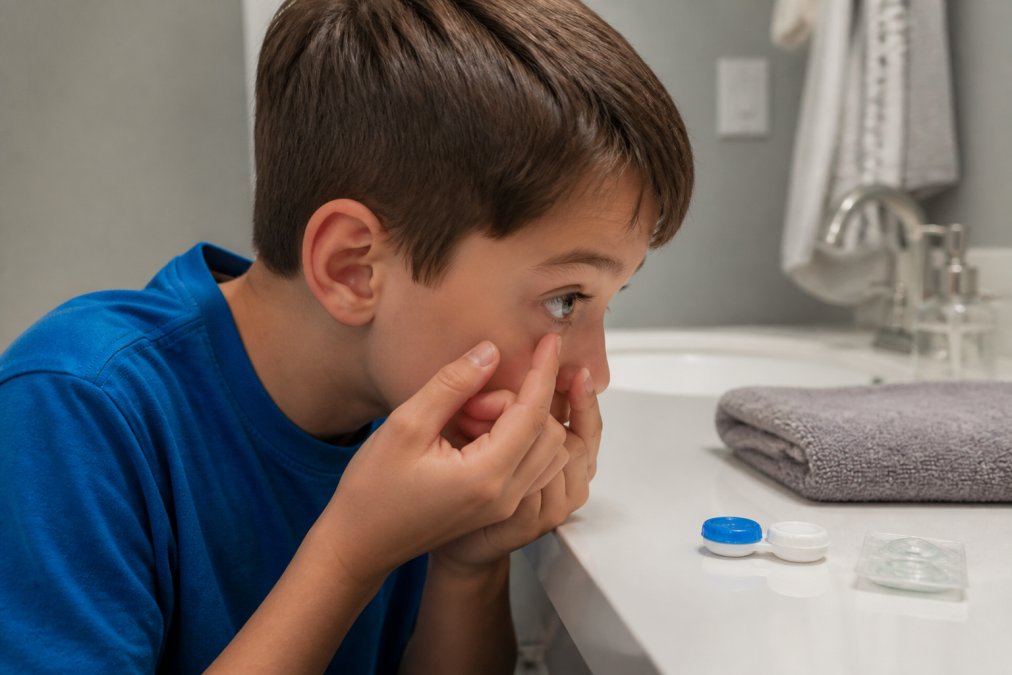
Overnight wear eliminates the daily insertion and removal routine that challenges many young contact lens wearers. Your child handles lenses only at bedtime and morning, when they're at home with parental support. This structure supports compliance, which directly impacts effectiveness. Once the lenses are out in the morning, nothing sits on your child's eyes all day, ideal for kids in sports, outdoor activities, or water-based recreation.
Myopia Management for Children: What the Research Shows
For parents watching their child's prescription strengthen year after year, the question becomes urgent: Can we actually slow this progression? Ortho-k has emerged as one of the few interventions with evidence suggesting it can.
How ortho-k slows myopia progression
Myopia progression is driven by axial elongation, the gradual lengthening of the eyeball. By flattening the central cornea and steepening the peripheral cornea, ortho-k lenses create a different optical environment that may signal the eye to slow its elongation. Children wearing ortho-k lenses tend to experience slower myopia progression compared to children wearing glasses or daytime soft contacts. Most children still see some increase in myopia over time, but the rate of change often decreases measurably.
This is significant because high myopia (typically -5.00D or greater) carries increased risk for serious eye conditions later in life, including retinal detachment, glaucoma, and myopic macular degeneration (peer-reviewed research). Slowing progression during the critical growth years reduces the likelihood your child develops high myopia by adulthood.
Long-term eye health benefits
The long-term eye health argument for ortho-k centers on progression control. A child who would have developed -7.00D myopia by age 18 without intervention might instead develop -4.50D with consistent ortho-k wear. That difference compounds across a lifetime. Lower myopia in adulthood means lower risk of sight-threatening complications decades later. Wilck Schwartz & Novak OD PC emphasizes this long-term perspective when discussing myopia management with families.
Is Your Child a Good Candidate for Ortho-K?
Not every child benefits equally from ortho-k. Age, prescription strength, astigmatism, and personality all factor into whether this approach makes sense for your family.
Age, prescription, and lifestyle factors
Ortho-k works best in children aged 8 and older. Younger children often lack the fine motor control and responsibility needed to handle rigid lenses safely.
Prescription strength matters significantly. Ortho-k lenses correct myopia up to approximately -6.00D and astigmatism up to about -1.75D (aao.org). Children with prescriptions beyond these ranges may not achieve full daytime vision correction with ortho-k alone.
Lifestyle is equally important. A child who plays contact sports, spends significant time in water, or has a history of eye allergies faces higher risks with any contact lens. Ortho-k requires consistent nightly wear and careful lens hygiene.
Compliance and responsibility readiness
This is the real gatekeeper. Ortho-k only works if your child wears the lenses most nights. You'll need to assess honestly: Is your child reliable? Can they handle a nightly routine? Are they willing to learn proper lens care?
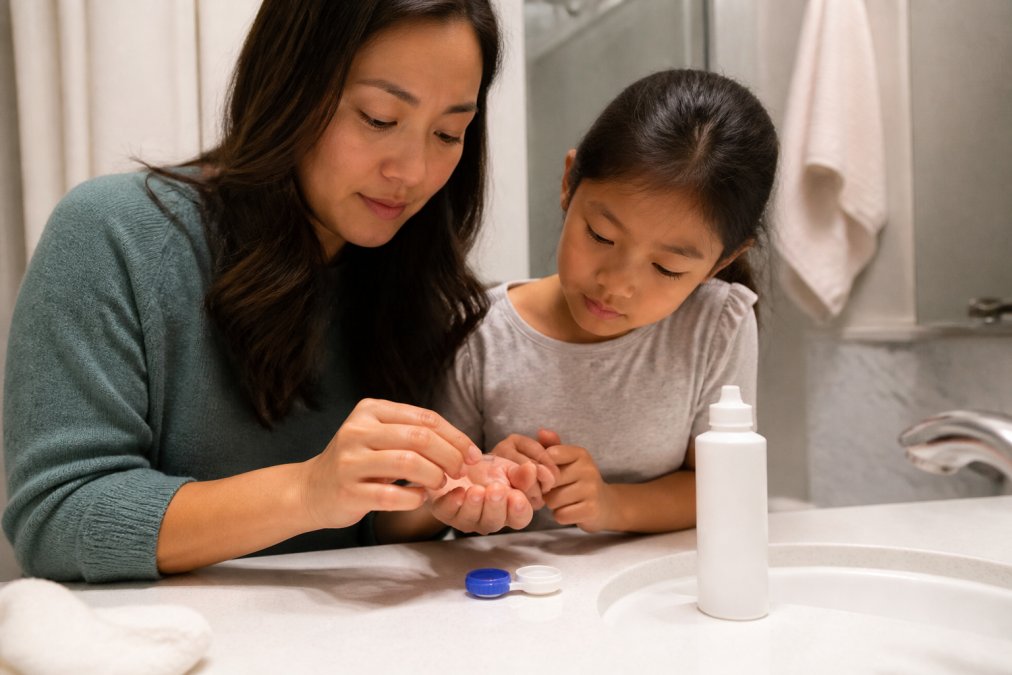
Your child needs to understand why lens hygiene matters. They need to use fresh solution each night, never reuse old solution, clean the lens case regularly, and handle lenses without contaminating them. Plan on being involved in the process, at least for the first several months until the routine becomes automatic.
How to Schedule Pediatric Eye Exams and Ortho-K Fittings
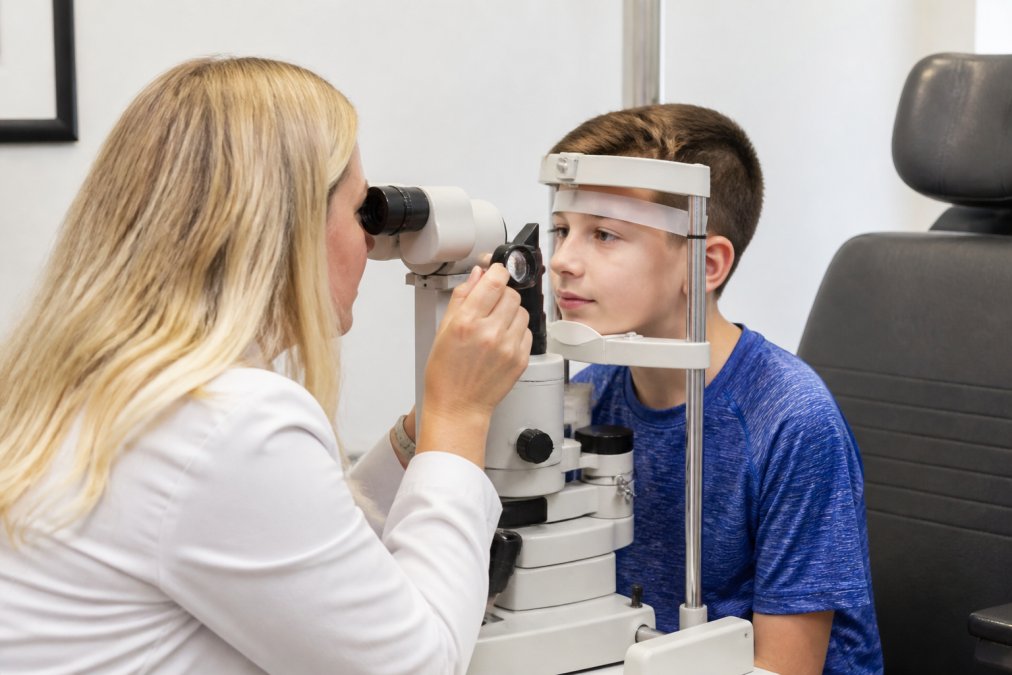
If you're considering ortho-k, the first step is a comprehensive pediatric eye exam with an eye care professional experienced in orthokeratology. Not every optometrist or ophthalmologist fits ortho-k lenses.
What to expect during the initial consultation
A consultation begins with a detailed eye health and vision history. The eye care professional will ask about your child's current vision symptoms, family history of myopia, and how quickly their prescription has been changing.
The clinical exam includes visual acuity testing, refraction to determine your child's current prescription, and corneal topography, the detailed mapping of your child's corneal surface. This topography is essential; it shows the eye care professional the exact shape of your child's cornea and helps determine whether ortho-k is feasible. The eye care professional will also assess tear film quality and evaluate the health of the cornea and conjunctiva. Ask about the fitting process, expected timeline, cost considerations, and what happens if ortho-k doesn't work for your child.
The fitting process and follow-up care
If you and the eye care professional decide ortho-k is appropriate, your child will be fitted with trial lenses designed based on their corneal topography and prescription. Your child will wear the trial lenses overnight and return the next day for evaluation. Once custom lenses arrive, your child begins regular wear with frequent initial follow-up appointments, typically at one week, two weeks, one month, and then monthly for the first few months. After the first few months, follow-ups typically space out to every 3-6 months. Throughout treatment, your child will need regular comprehensive eye exams to monitor overall eye health and track whether myopia progression is actually slowing.
Ortho-K vs. Soft Contact Lenses: Which Is Better for Your Child?
When comparing ortho-k to traditional soft contact lenses, the choice depends on what matters most to your family: convenience, myopia control, or cost.
Comparison of effectiveness and convenience
| Factor | Ortho-K | Soft Contact Lenses |
|---|---|---|
| Daytime vision correction | Clear vision without lenses or glasses | Requires lens insertion each morning |
| Myopia progression control | Potential to slow progression | No effect on progression |
| Wear schedule | Overnight only (6-10 hours) | All waking hours |
| Handling | Rigid lenses; requires careful technique | Easier insertion and removal for most children |
| Water activities | Must remove before swimming | Can wear during water activities |
| Comfort | Takes time to adapt; initial awareness of lens | Generally more comfortable once adapted |
| Reversibility | Fully reversible; cornea returns to original shape | Immediate reversal when lenses are removed |
Soft contact lenses offer simplicity and no overnight commitment. But soft lenses don't slow myopia progression. If your primary concern is controlling how quickly your child's prescription strengthens, soft lenses alone won't address that goal.
Ortho-k trades convenience for the possibility of myopia control. Your child gives up daytime lens-free vision in exchange for the overnight routine. But if that routine successfully slows progression, the trade-off may be worth it over a 5-10 year period.
Cost, maintenance, and daily wear considerations
Soft contact lenses have lower upfront costs but require ongoing expenses for solution, replacement lenses, and regular eye exams. Ortho-k typically has higher initial costs but lower daily material costs since your child uses the same pair of lenses nightly.
Soft lenses require daily cleaning and storage in fresh solution. Ortho-k lenses require nightly cleaning with specialized solution and regular lens case replacement. Soft lenses offer more flexibility; if your child has a sleepover or forgets their ortho-k lenses, soft lenses are easier to manage. Ortho-k requires consistency; missing multiple nights can disrupt the corneal reshaping and reduce the myopia control benefit.
Real Challenges: Safety, Compliance, and What Parents Should Know
Ortho-k isn't risk-free, and understanding the real challenges helps you make an informed decision.
Lens hygiene and infection prevention
Rigid gas permeable lenses, including ortho-k lenses, carry infection risk if not handled properly. The lenses sit on the cornea overnight, and any bacteria or debris trapped under the lens can multiply in the warm, moist environment of the eye. Corneal infections from contact lenses can cause pain, redness, vision loss, and in severe cases, permanent corneal scarring.
Preventing infection depends entirely on your child's hygiene practices. The lenses must be cleaned nightly with appropriate solution, never reused solution, and stored in a clean case. The case itself must be cleaned and air-dried daily. Your child's hands must be clean before touching lenses. Many eye infections from contact lens wear happen because children skip steps or cut corners.
Discontinuation and reversibility
Ortho-k is reversible, but the process takes time. Once your child stops wearing the lenses, the cornea gradually returns to its original shape over days to weeks. During this transition period, your child's vision will blur as the cornea reshapes. They'll need glasses or soft contact lenses to see clearly during this period.
The myopia control benefit also reverses. Once your child stops wearing ortho-k, their myopia progression returns to whatever their natural rate would be. This is important to understand: ortho-k manages myopia while your child wears the lenses, but doesn't permanently alter the underlying tendency toward myopia.
Insurance coverage and out-of-pocket costs
Insurance coverage for ortho-k varies widely. Some plans cover ortho-k as a vision correction method and reimburse a portion of fitting and lens costs. Others classify it as an elective or experimental treatment and don't cover it at all.
Before pursuing ortho-k, contact your insurance provider and ask specifically about coverage for orthokeratology lenses, fitting fees, and follow-up care. Get the answer in writing if possible. Some families use Health Savings Accounts (HSAs) or Flexible Spending Accounts (FSAs) to pay for ortho-k if these accounts are available through their employer. Out-of-pocket costs vary by provider and location, with geographic differences significant.
Making the Decision: Is Ortho-K Right for Your Family?
This decision ultimately hinges on three questions: Does your child have the responsibility and compliance capacity? Are you willing to commit to the nightly routine and hygiene requirements? Does the potential myopia control benefit justify the cost and commitment for your family?
If your child's myopia is progressing rapidly and you're concerned about high myopia developing, ortho-k deserves serious consideration. The potential to slow progression during critical growth years has real long-term implications for eye health.
If your child is resistant to routines, frequently forgets responsibilities, or has a history of allergies or dry eyes, ortho-k may create more problems than it solves.
If cost is a significant barrier, soft contact lenses or glasses remain effective vision correction options, even if they don't manage myopia progression.
The best way to move forward is a consultation with an eye care professional experienced in pediatric ortho-k. They can assess whether your child is a good candidate, explain realistic expectations, and answer specific questions about your family's situation. Wilck Schwartz & Novak OD PC offers comprehensive pediatric eye exams and can discuss whether ortho-k aligns with your child's vision needs and your family's lifestyle.
Deciding whether ortho-k is right for your child requires weighing real benefits against genuine challenges. If your child is a good candidate and your family can commit to the nightly routine and lens care requirements, ortho-k offers the advantage of clear daytime vision without glasses or daytime contacts, plus the possibility of slowing myopia progression during crucial growth years. Schedule a comprehensive pediatric eye exam with an experienced optometrist or ophthalmologist specializing in myopia management to discuss whether ortho-k makes sense for your child's specific situation. Wilck Schwartz & Novak OD PC provides advanced optometric equipment and specialized expertise to assess your child's candidacy and guide you through the fitting process with thorough follow-up care.
Frequently Asked Questions
At what age can my child start wearing ortho-k lenses?
Children as young as 6 years old can be fitted for ortho-k lenses, though most practitioners recommend waiting until a child demonstrates responsibility with daily routines. The ideal age range is typically 8-12 years old, when myopia progression is often most rapid and children can follow lens care instructions reliably. Your eye care professional will assess your individual child's maturity level, prescription stability, and ability to handle overnight lens wear before recommending ortho-k.
How effective is ortho-k at slowing myopia progression in children?
Research shows ortho-k can slow myopia progression by 30-60% in children compared to those wearing glasses or standard daytime contact lenses. The effectiveness depends on consistent overnight wear, proper lens fit, and individual corneal response. Most children experience clear daytime vision without correction while wearing ortho-k overnight. Results vary, so your eye care provider can discuss realistic outcomes based on your child's specific prescription and eye health.
Is ortho-k covered by vision insurance plans?
Coverage for ortho-k varies significantly by insurance plan. Most traditional vision insurance plans classify ortho-k as a specialty service and may cover only a portion of the cost, if at all. Some plans cover the fitting exam but not the lenses themselves. Check your specific plan details or contact your insurance provider directly. Many families use Health Savings Accounts (HSAs) or Flexible Spending Accounts (FSAs) to help cover ortho-k costs, which may be eligible depending on your plan.
What happens if my child stops wearing ortho-k lenses?
The corneal reshaping from ortho-k is temporary and completely reversible. If your child stops wearing the lenses, the cornea gradually returns to its original shape over several days to weeks, and myopia returns to its previous level. This reversibility makes ortho-k a low-risk option if it doesn't work for your family or if your child's needs change. However, during the transition period without correction, your child may need glasses or daytime contacts until the cornea fully returns to normal.
This article was written using GrandRanker