 how-to
Why Children Get Headaches Reading: Vision & Eye Strain
Table of Contents
- Why Children Get Headaches Reading: The Vision Connection
- Common Causes of Reading Headaches in Children
- Recognizing Pediatric Eye Strain Symptoms
- Signs of Vision Problems in Children Beyond Headaches
- How to Schedule Pediatric Eye Exams for Reading Headaches
- What Happens During a Comprehensive Pediatric Eye Exam
- When to Seek Immediate Care for Pediatric Headaches
- Ergonomic and Home-Based Steps to Reduce Reading Headaches
- Frequently Asked Questions
Last Updated: August 19, 2026
Why Children Get Headaches Reading: The Vision Connection
Reading headaches in children signal that their visual system is working harder than it should during sustained near work. The connection is straightforward: reading demands intense focusing effort from the eye's internal muscles. Uncorrected refractive errors, convergence insufficiency, and digital eye strain are the primary culprits, but many parents don't realize these conditions exist until headaches bring them to an eye care professional.
At Wilck Schwartz & Novak OD PC, we've seen countless children whose reading headaches disappeared after a comprehensive eye exam revealed treatable vision problems that school screenings had missed. The difference is precision: school screenings catch obvious vision loss, but they don't assess the subtle focusing and alignment issues that cause reading-specific headaches. Understanding why children get headaches reading starts with recognizing that the visual system involves how the eyes focus, how they work together, and how much effort that coordination demands.
Common Causes of Reading Headaches in Children
Reading headaches in children stem from a specific set of vision-related issues that deserve professional evaluation beyond a school screening.
Uncorrected Refractive Errors
Refractive errors, myopia, hyperopia, and astigmatism, are the most frequent cause of reading headaches. When a child is hyperopic (farsighted), their eyes must work harder to focus on near objects like text, fatiguing the ciliary muscles and triggering headaches within 20-30 minutes of reading.
Hyperopia often goes undetected because the child compensates by squinting or moving the book closer, both of which increase the workload on the focusing system. Astigmatism compounds the issue: when the cornea or lens has an irregular shape, light focuses unevenly on the retina, forcing the eyes to work harder to sharpen the image. Reading becomes exhausting with uncorrected astigmatism.
Convergence Insufficiency and Eye Misalignment
Convergence insufficiency occurs when the eyes struggle to turn inward together during near work. When reading, both eyes need to point at the same spot on the page through coordinated inward movement called convergence. If the eyes don't converge smoothly, the brain receives conflicting signals, triggering eye strain and headaches.
Binocular vision dysfunction, a broader category including convergence insufficiency and other alignment problems, is one of the most overlooked causes of pediatric reading headaches. The child's eyes may look perfectly straight and have clear vision individually, but the two eyes aren't working as a coordinated team. This forces the brain to work harder to merge the two slightly different images, manifesting as fatigue and headaches during reading. A child might have a small phoria (latent misalignment) that only becomes apparent during sustained near work, requiring constant overcorrection that triggers headaches after 15-20 minutes.
Digital Eye Strain and Near Work Fatigue
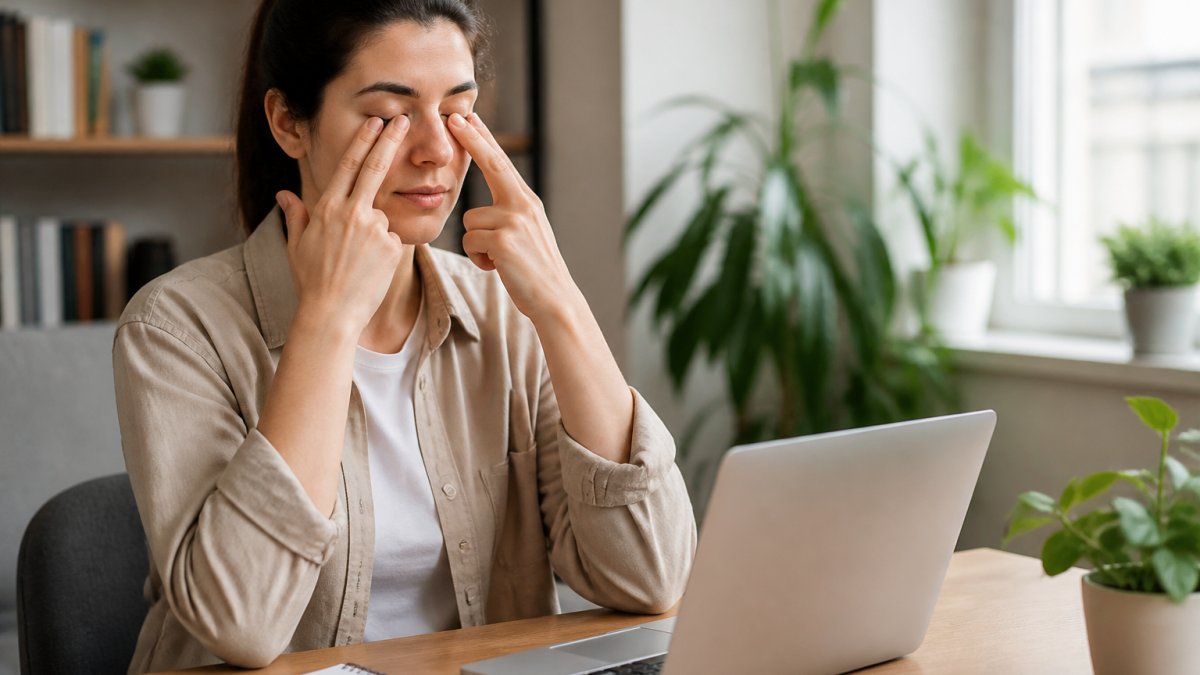
Modern reading on screens introduces additional stress: reduced blinking and constant accommodation at a fixed distance. When children read on tablets or computers, they blink 66% less frequently than normal, which dries the ocular surface and increases discomfort.
Digital eye strain combines reduced blinking, glare from screens, poor posture, and sustained focus at a fixed distance. The accommodation mechanism remains locked at a single distance for extended periods, fatiguing the ciliary muscles and causing headaches. Screen work involves additional visual demands and typically worse posture than physical book reading, creating a perfect storm for headaches.
Recognizing Pediatric Eye Strain Symptoms
Eye strain in children presents differently than in adults because children often can't articulate what they're experiencing. Instead of saying "my eyes hurt," a child might say their head hurts, they're tired, or they don't want to read.
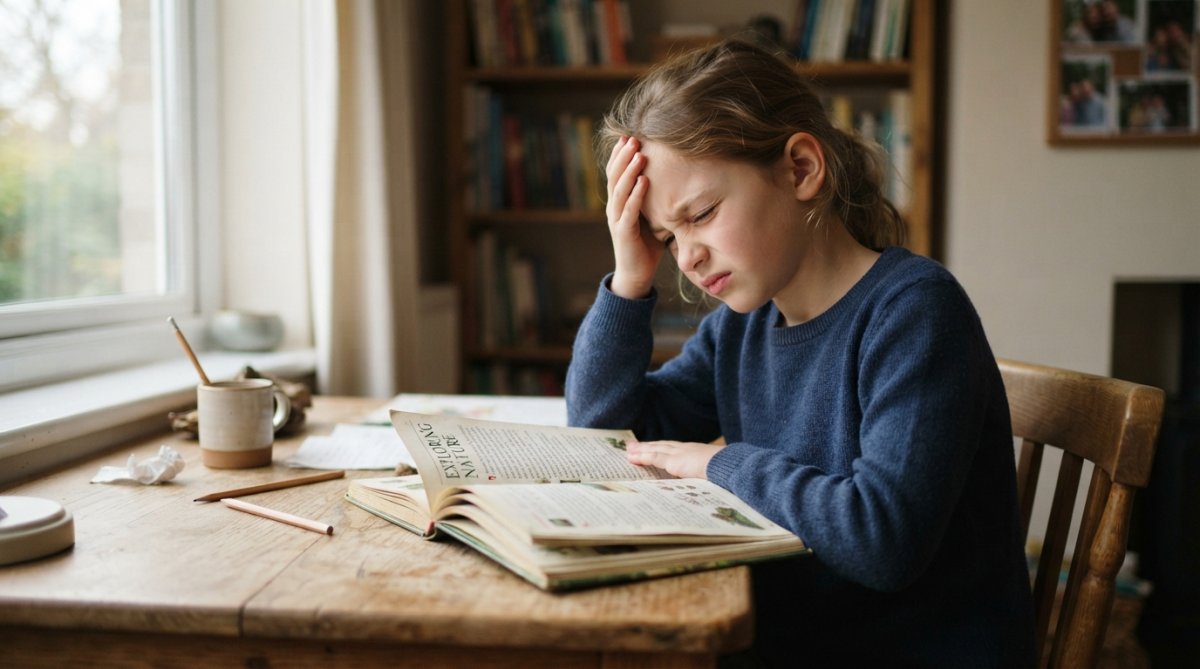
The most obvious sign is that headaches appear specifically during or shortly after reading and resolve when the child stops. The headache is typically mild to moderate, located in the forehead or temples, and may be accompanied by eye discomfort, blurred vision, or the sensation that words are "moving around" on the page.
Physical symptoms include eye redness, watery or dry eyes, visible squinting, and eye rubbing. A child might close one eye while reading or hold the book very close, both compensatory behaviors suggesting the visual system is working too hard. Some children tilt their head to one side while reading, often indicating convergence insufficiency or astigmatism.

Behavioral changes are equally important. A child who previously enjoyed reading but now avoids it, or who complains about reading class, may be experiencing undiagnosed eye strain. Some children are labeled as having poor attention when the real issue is that reading causes physical discomfort. If headaches appear after just 10-15 minutes of reading, that's a strong signal that the visual system is under significant stress.
Signs of Vision Problems in Children Beyond Headaches
Reading headaches are often the first symptom of a vision problem, but they're rarely the only one. Difficulty with depth perception or coordination can indicate binocular vision dysfunction. A child who struggles with sports, bumps into things frequently, or has trouble catching a ball may have an underlying alignment or focusing issue that also causes reading headaches.
Academic performance often reflects undiagnosed vision problems. A child with convergence insufficiency or uncorrected refractive error may fall behind in reading-heavy subjects not because they lack ability but because reading is physically uncomfortable. Complaints about glare, difficulty in bright lighting, or sensitivity to fluorescent lights can signal astigmatism or other refractive errors. acupuncture for migraines.
Behavioral signs include excessive blinking, frequent eye rubbing, squinting, tilting the head, or holding reading material at unusual distances, all red flags that the visual system needs professional assessment.
How to Schedule Pediatric Eye Exams for Reading Headaches
Scheduling an eye exam for a child with reading headaches requires knowing what to ask for and what to expect. A standard school screening won't identify many conditions that cause reading-specific headaches.
Start by describing the specific symptom pattern: headaches that appear during reading, how long it takes for them to develop, and whether they're tied to screen time or physical books. Request a comprehensive pediatric eye exam, not just a visual acuity check. A comprehensive exam includes assessment of accommodation (focusing ability), convergence (how the eyes work together), and binocular vision function, the exact areas that cause reading headaches.
When booking an appointment at Wilck Schwartz & Novak OD PC or any pediatric eye care practice, mention that the child has reading-related headaches. Bring relevant history: family history of vision problems, when headaches started, whether they're worse at the end of the school day, and any recent changes in reading habits or screen time. Insurance coverage for pediatric eye exams varies; many plans cover one comprehensive exam per year for children under 18.
What Happens During a Comprehensive Pediatric Eye Exam
A comprehensive pediatric eye exam for reading headaches goes well beyond standard screening. The optometrist will assess the specific visual functions that affect reading comfort.
The exam begins with visual acuity testing in age-appropriate ways. The optometrist will check both distance and near vision, paying particular attention to how clearly the child sees at reading distance. Refraction testing determines whether the child has a refractive error, identifying myopia, hyperopia, astigmatism, or combinations, the single most important test for reading headaches.
Accommodation testing measures how well the eye's focusing muscles work and how quickly the eye can shift focus between distances. Convergence testing evaluates how well the eyes turn inward together during near work. Binocular vision testing includes cover tests and specialized assessments to evaluate how well the two eyes work as a team, where many subtle alignment issues are identified.
Ocular health evaluation examines the front and back of the eye to rule out infections, inflammation, or other pathology, and assesses tear production and ocular surface health.
When to Seek Immediate Care for Pediatric Headaches
While most reading-related headaches are benign and vision-related, some warrant immediate attention. Seek immediate care if a headache is accompanied by vision loss, severe eye pain, eye redness, or discharge, which suggest infection, inflammation, or trauma rather than eye strain.
Headaches with neurological symptoms, dizziness, confusion, difficulty speaking, weakness, or numbness, are not vision-related and require emergency evaluation. A sudden change in headache pattern is concerning. If headaches begin to occur during activities other than reading, the cause may not be vision-related. Headaches accompanied by behavioral changes, difficulty concentrating, or school performance decline might indicate migraine or other neurological issues. If a child has a history of head trauma, recent vision changes, or family history of migraine, reading headaches deserve comprehensive evaluation.
Ergonomic and Home-Based Steps to Reduce Reading Headaches
While professional eye care addresses the underlying vision problem, ergonomic adjustments can reduce strain and provide immediate relief.
Proper posture is foundational. The child should sit upright with the book or screen positioned 10-14 inches from the eyes, slightly below eye level. The book should be at a slight angle (about 20 degrees) rather than flat on the desk, which reduces neck bending and improves visual access.

Lighting is critical. A desk lamp positioned to the side provides adequate illumination. Avoid reading in direct sunlight or under harsh fluorescent lights. For screens, position them at arm's length and slightly below eye level. Reduce screen brightness to match the surrounding environment and enable blue light filters if screen time is substantial. Enforce the 20-20-20 rule: every 20 minutes of screen time, look at something 20 feet away for 20 seconds.
Reading breaks prevent cumulative fatigue. A child should not read continuously for more than 30-45 minutes without a break. During breaks, encourage looking at distant objects, which relaxes the focusing muscles. Ensure adequate font size so the child doesn't need to lean closer to the page. Reduce environmental distractions to allow focus without additional stress.
Reading headaches in children are a sign that something in the visual system needs attention. Whether it's an uncorrected refractive error, convergence insufficiency, or simple eye strain from poor ergonomics, the solution begins with understanding what's causing the problem. A comprehensive eye exam is the essential first step, and it's the step that school screenings often miss. At Wilck Schwartz & Novak OD PC, we specialize in pediatric eye care and understand how vision problems specifically affect reading and learning. Our team uses advanced optometric equipment to identify the subtle focusing and alignment issues that cause reading headaches, then develops a treatment plan tailored to your child's needs. Schedule an appointment and give your child the visual foundation they need to read comfortably and succeed in school.
Frequently Asked Questions
Can uncorrected vision problems cause school-related headaches?
Yes. Uncorrected refractive errors, nearsightedness, farsightedness, or astigmatism, force children's visual system to work harder during near work like reading. This extra focusing effort creates eye strain and tension headaches. A comprehensive eye exam can identify these problems before they affect school performance and comfort.
What are the common symptoms of digital eye strain in children?
Pediatric eye strain symptoms include headaches, blurred vision, eye fatigue, difficulty concentrating, and rubbing eyes frequently. Children may also complain of dry or burning eyes, especially after screen time or reading. These symptoms often improve with breaks but return when near work resumes.
When should I be worried about my child's headaches?
Seek immediate care if headaches are severe, sudden, accompanied by vision loss, vomiting, dizziness, or neurological symptoms. Recurring reading-related headaches that improve with rest are usually eye-strain related, but a pediatric eye exam can rule out other causes and confirm the vision connection.
How often should children have eye exams to prevent reading headaches?
Children should have comprehensive eye exams every 1-2 years, or more frequently if they report headaches during reading or school. Early detection of vision problems prevents the eye strain and tension that lead to chronic headaches, ensuring children have the visual resources for normal development and learning.
This article was written using GrandRanker