 ultimate-guide
Can a Child Outgrow Strabismus? What Parents Need to Know
Table of Contents
- Understanding Strabismus: What It Is and Why It Matters
- Can a Child Outgrow Strabismus on Their Own?
- Signs of Strabismus in Toddlers and Young Children
- When Treatment Becomes Necessary
- Non-Surgical and Surgical Treatment Options
- How to Schedule Pediatric Eye Exams
- The Psychological and Social Impact of Untreated Strabismus
- Conclusion
- Frequently Asked Questions
Last Updated: September 4, 2026
Understanding Strabismus: What It Is and Why It Matters
Strabismus is a condition where the eyes do not align properly, causing one eye to look straight ahead while the other turns inward, outward, upward, or downward. It affects binocular vision and depth perception, and it is one of the most common pediatric eye conditions that optometrists diagnose in young children. When parents notice their child's eyes wandering, the immediate question is often whether this is a passing phase or something that requires professional attention.
At Wilck Schwartz & Novak OD PC, we have served families in Brooklyn since 1964, and helping parents understand the difference between a temporary misalignment and a true condition is part of our daily work. The answer to whether a child can outgrow strabismus is not a simple yes or no. It depends on the type of misalignment, the child's age, and whether underlying issues like refractive error or amblyopia are present. Early intervention matters because the visual system develops rapidly during the first several years of life, and untreated misalignment can lead to permanent visual impairment.
The good news is that most forms of strabismus are highly treatable when caught early. Pediatric ophthalmology guidelines emphasize that the goal is to preserve vision in both eyes, restore eye coordination, and support normal vision development. What follows is a practical guide for parents who want to understand what their child's eye misalignment means and what steps to take next.
Can a Child Outgrow Strabismus on Their Own?
Some children do outgrow intermittent strabismus, but most cases of constant eye misalignment require treatment. The distinction comes down to how often the eyes wander and whether the brain is learning to ignore the misaligned eye. If a child's eyes are crossed or wandering more than a small fraction of the time, waiting to see if they outgrow it carries real risks.
The visual system builds connections between the eyes and the brain during early childhood. When the eyes are misaligned, the brain receives two different images and may suppress the input from one eye to avoid double vision (aao.org). That suppression can lead to amblyopia, commonly called lazy eye, where the brain permanently favors one eye. A child who appears to outgrow strabismus without treatment may actually be suppressing vision in one eye, which is why professional evaluation is essential.
Most pediatric eye care specialists recommend that any child with a constant eye misalignment be examined rather than observed. The longer misalignment persists, the harder it becomes to restore normal binocular vision and depth perception. A comprehensive eye exam can determine whether the misalignment is truly resolving or whether the brain is simply adapting in a way that compromises long-term vision.
Pseudostrabismus vs. True Strabismus
Not every appearance of crossed eyes is actually strabismus. Pseudostrabismus is a common condition in infants and toddlers where the eyes appear misaligned but are actually working together correctly. It occurs when a child has a wide, flat nasal bridge or prominent skin folds near the inner corners of the eyes, which can obscure part of the white of the eye and create the illusion of crossing.
The key difference is that pseudostrabismus does not affect eye coordination or visual acuity. A pediatric eye care professional can distinguish between pseudostrabismus and true strabismus through an examination that checks how the eyes move together and whether each eye maintains proper fixation on a focal point. If pseudostrabismus is the diagnosis, no treatment is needed, and the appearance typically resolves as the child's facial features mature.
True strabismus, by contrast, involves an actual misalignment of the visual axes. Esotropia refers to eyes that turn inward, while exotropia describes eyes that turn outward. Both forms require evaluation to determine whether treatment is needed to protect vision development.
Signs of Strabismus in Toddlers and Young Children
Parents are often the first to notice signs of strabismus in toddlers, but the condition can be subtle. Common indicators include eyes that appear to cross or drift, a child who tilts their head to look at objects, or squinting in bright light. Some children close one eye to see clearly, which is a sign that the brain is struggling to merge images from both eyes.
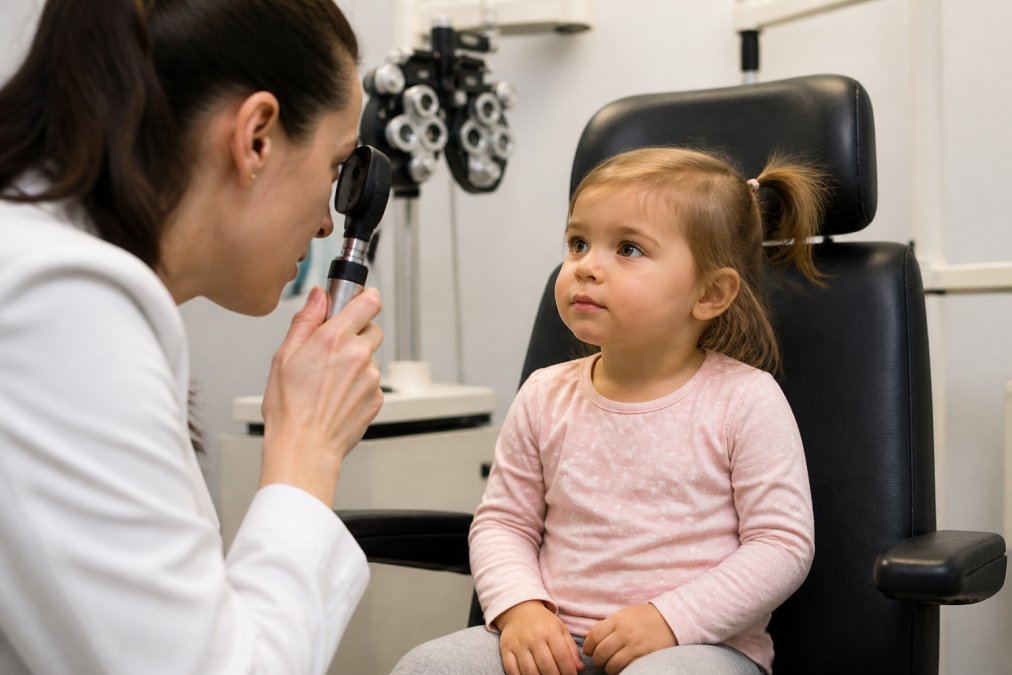
Difficulty with depth perception is another clue. A toddler who frequently misses when reaching for objects, stumbles on stairs, or seems clumsy may be struggling with binocular vision. Older children might complain of headaches, eye strain, or double vision, though many adapt so gradually that they do not realize their vision is abnormal.
School eye screenings can miss strabismus, particularly if the misalignment is intermittent or if the child compensates by using one eye. A comprehensive pediatric eye exam includes tests for ocular motility, eye coordination, and refractive error that go beyond basic visual acuity screening. If your child shows any of these signs, scheduling an evaluation with an optometrist who sees children regularly is the safest course of action.
When Treatment Becomes Necessary
Treatment becomes necessary when strabismus threatens vision development, causes double vision, or affects a child's ability to use both eyes together. The decision is based on the frequency of misalignment, the child's age, and whether amblyopia or significant refractive error is present. Constant misalignment almost always requires treatment because the brain cannot develop normal binocular vision when the eyes are not working as a team.
Stereopsis, the ability to perceive depth using both eyes, develops in early childhood and depends on the eyes being properly aligned during a critical window (peer-reviewed research). If that window passes without treatment, the ability to develop full depth perception may be lost permanently. This is why pediatric eye care professionals emphasize early intervention rather than a watch-and-wait approach for true strabismus.
Untreated strabismus in childhood also carries long-term consequences beyond vision. Adults who had untreated strabismus as children often report lower self-confidence and social challenges related to their eye appearance. Treating strabismus early addresses both the visual and the psychological aspects of the condition.
Early Intervention and Long-Term Outcomes
The phrase "the earlier, the better" applies directly to strabismus treatment. Children who receive treatment during the critical period of vision development have the best chance of achieving normal visual acuity in both eyes, good eye coordination, and functional depth perception. Treatment outcomes are measured not just by how straight the eyes look, but by whether the child can use both eyes together effectively.
Long-term prognosis for children treated for strabismus is generally positive. Most children respond well to a combination of corrective lenses, patching therapy, and in some cases, eye muscle surgery. The key is consistent follow-up care, since vision development continues throughout childhood and alignment can shift as the eyes grow.
Non-Surgical and Surgical Treatment Options
Strabismus treatment falls into two broad categories: non-surgical approaches and surgery. The choice depends on the type and severity of the misalignment, the child's age, and whether amblyopia is present. Most treatment plans start with the least invasive options and progress only if needed.
Non-surgical treatments include:
- Corrective lenses to manage refractive error that may be causing the eyes to work harder than necessary
- Prism glasses that alter how light enters the eye and can reduce the effort required to maintain alignment
- Patching therapy to strengthen a weaker eye and treat amblyopia
- Vision therapy, which uses structured exercises to improve eye coordination and focusing skills
Eye muscle surgery is reserved for cases where non-surgical approaches do not achieve adequate alignment. The procedure adjusts the tension on the muscles that control eye movement, allowing the eyes to align more naturally. Strabismus surgery is typically performed on an outpatient basis, and most children resume normal activities within a short recovery period.
Vision Therapy for Children
Vision therapy for children is a structured program of supervised exercises designed to improve eye coordination, focusing, and visual processing. Unlike patching, which works on strengthening a single eye, vision therapy trains both eyes to work together as a team. It is often used in combination with other treatments to address the underlying eye coordination issues that contribute to strabismus.
A typical vision therapy program involves regular sessions with an optometrist or orthoptist, supplemented by exercises the child does at home. Activities might include tracking moving objects, converging on near targets, or using specialized equipment to train sensory fusion. The goal is to help the brain learn to use both eyes together, which supports lasting alignment and depth perception.
| Treatment Option | Primary Goal | Typical Use |
|---|---|---|
| Corrective lenses | Manage refractive error | First-line for accommodative esotropia |
| Patching therapy | Strengthen amblyopic eye | Used when one eye is significantly weaker |
| Prism glasses | Reduce double vision | Temporary or long-term alignment support |
| Vision therapy | Train eye coordination | Adjunct to lenses or patching |
| Eye muscle surgery | Realign the eyes | When non-surgical options are insufficient |
Vision therapy requires commitment from both the child and the parents. Sessions are most effective when exercises are practiced consistently at home, and progress is monitored through regular follow-up visits. For families in Brooklyn, working with a practice that offers pediatric vision therapy under one roof simplifies the process considerably.
How to Schedule Pediatric Eye Exams
Knowing how to schedule pediatric eye exams is the first practical step for any parent concerned about their child's eye alignment. The American Optometric Association recommends that children have their first comprehensive eye exam around six months of age, another at age three, and again before starting school (aoa.org). Children with risk factors such as a family history of strabismus or amblyopia may need earlier or more frequent exams.
Scheduling is straightforward. Contact the optometry practice directly and explain that you are requesting a pediatric exam because you have concerns about eye alignment. The office will let you know what to bring, including any records from previous screenings or exams. A comprehensive pediatric exam typically takes about an hour and includes tests designed to assess how well the eyes work together, not just how clearly each eye sees.
For families in Brooklyn, Wilck Schwartz & Novak OD PC offers pediatric eye exams using advanced optometric equipment that allows precise assessment of eye alignment and coordination. Our team has served the community since 1964, and many of our patients are referrals from multigenerational families who have trusted us with their children's vision care for decades. Early detection of strabismus gives us the best opportunity to protect your child's vision development and long-term ocular health.
The Psychological and Social Impact of Untreated Strabismus
The visual consequences of untreated strabismus are well documented, but the psychological impact is just as significant and often overlooked. Children with visible eye misalignment face social challenges that can affect their confidence and self-esteem. They may be teased by peers, feel self-conscious in photographs, or avoid activities that draw attention to their eyes.
Research consistently shows that children with strabismus are rated less favorably by their peers in terms of attractiveness and social competence. These perceptions can follow a child into adolescence and adulthood, affecting everything from friendships to professional opportunities. Adults with untreated strabismus often report that having their eyes aligned later in life improved not just their vision, but their overall quality of life and self-image.
Treating strabismus in childhood addresses both the visual and the emotional dimensions of the condition. When a child's eyes align properly, they gain not only binocular vision and depth perception, but also the confidence that comes from looking and feeling like everyone else. This dual benefit is a compelling reason to pursue treatment rather than waiting to see if the condition resolves on its own.
Conclusion
The question of whether a child can outgrow strabismus or need treatment has a clear answer: some intermittent cases resolve, but true strabismus almost always requires professional intervention to protect vision development and prevent long-term consequences. The visual system builds its foundation in early childhood, and the window for optimal treatment is limited.
For parents, the most important takeaway is that early evaluation is the safest choice. A comprehensive pediatric eye exam can distinguish between pseudostrabismus and true misalignment, identify any underlying refractive error, and guide you toward the treatment approach that gives your child the best chance at normal binocular vision. Wilck Schwartz & Novak OD PC has served Brooklyn families since 1964, offering pediatric eye exams, vision therapy, and ongoing management of ocular health with advanced diagnostic technology. If you have concerns about your child's eye alignment, schedule an appointment and get the clarity you need to protect their vision for life.
Frequently Asked Questions
Can a child outgrow strabismus without treatment?
Some children with mild strabismus may experience natural improvement as their eye muscles develop, but true strabismus typically does not resolve on its own. The younger a child is diagnosed, the better the prognosis with early intervention. Waiting to see if the condition improves on its own risks permanent vision problems, including amblyopia (lazy eye) and loss of depth perception. A professional eye exam is essential to determine whether your child's eye misalignment requires treatment.
What are the signs of strabismus in toddlers?
Common signs include one eye turning inward, outward, upward, or downward while the other focuses straight ahead; frequent squinting or tilting the head to see; eye crossing that persists after three months of age; sensitivity to light; or difficulty following moving objects. Some children may also complain of double vision or eye strain. If you notice any of these signs, schedule a pediatric eye exam promptly. Early detection significantly improves treatment outcomes and prevents secondary vision problems.
What happens if strabismus is left untreated in children?
Untreated strabismus can lead to amblyopia (lazy eye), where the brain ignores signals from the misaligned eye, resulting in permanent vision loss in that eye. Children may also develop poor depth perception, affecting balance, coordination, and athletic ability. Beyond the physical effects, untreated strabismus can impact self-esteem and social confidence as children grow older. The longer the condition persists without intervention, the harder it becomes to restore normal binocular vision and eye coordination.
How should I schedule a pediatric eye exam for my child?
Contact a pediatric ophthalmologist or optometrist who specializes in children's eye care. Many practices, including comprehensive optometry offices, offer dedicated pediatric appointments with equipment and techniques designed for young patients. When scheduling, mention any specific concerns such as eye misalignment, vision problems, or family history of eye conditions. Early screening is recommended between 6 months and 3 years of age, even if no symptoms are apparent.
This article was written using GrandRanker